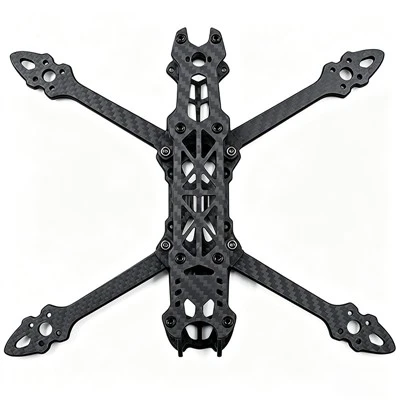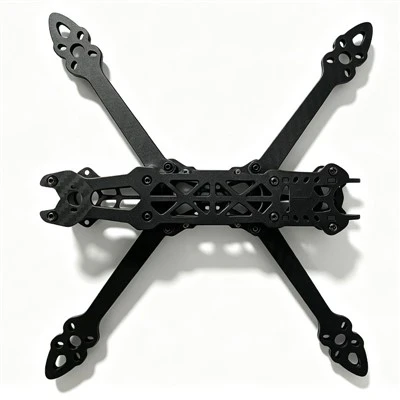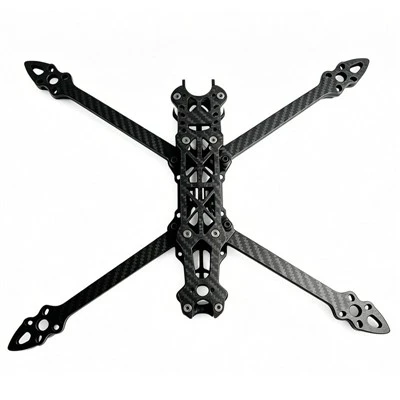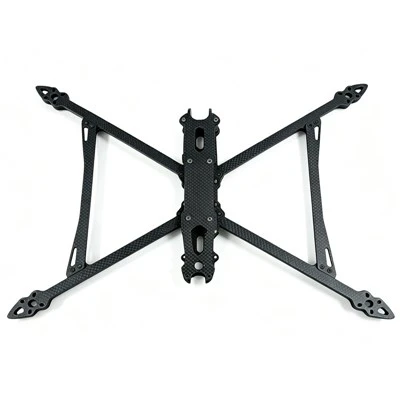
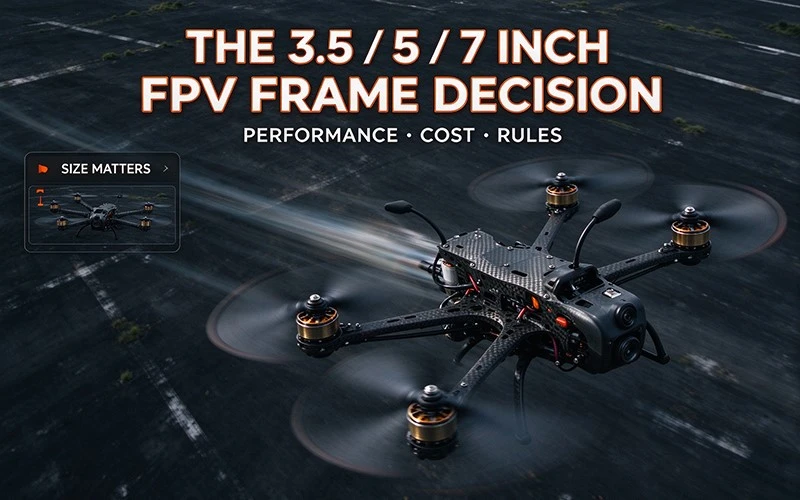
Choosing a frame size is the most foundational decision in building or buying an FPV drone-and the one that most shapes where and how you can fly. It determines not only handling, but where you can legally fly, how well the aircraft resists wind, what camera it can carry, and how expensive it is to repair after a crash. The rules and cost realities have shifted by 2026: sub-250g no longer means "fly anywhere," and a $100 5-inch build is no longer realistic. This guide puts the three mainstream classes-3.5-inch micro quads, 5-inch freestyle rigs, and 7-inch long-range cruisers-into one decision framework.
The Comparison Matrix at a Glance
| Metric | 3.5″ Micro | 5″ Freestyle | 7″ Long-Range |
|---|---|---|---|
| Primary Purpose | Backyard, park, low-risk practice; sub-250g compliance priority | Freestyle, bando, racing, mounting full-size action camera | Mountainous/coastal, heavy-duty, long-endurance |
| AUW (with battery) | 150–250g; sub-250g requires careful selection | 500–750g (including GoPro) | 800–1400g+ |
| Flight Time | 3–5 minutes | Takes 3–5 minutes to fly; cruises for 6–8 minutes. | Li-Ion 10–25+ minutes; LiPo 6–10 minutes |
| Noise | Low (high-frequency squeal, relatively friendly to neighbors) | Medium to high (signature roar) | High (low frequency, travels far) |
| Crash Durability | High (small mass, low kinetic energy) | Medium (sturdy, but speed causes breakage) | Low (high kinetic energy, high cost per single crash) |
| Wind Resistance | Bad to average | Excellent | Extremely strong (quality cutting through mountain turbulence) |
| Typical quad-only cost | Usually less than 5″ | $170–250 (confidence interval) | $350–550; the hidden cost of a crash is the highest |
| Regulatory burden | Lower, but not equal to exemption from registration. | Registration required + Remote ID (most markets) | Same as 5″, and has the highest requirements for the venue. |
Answer Three Questions Before Choosing a Size
First, what is your local regulatory hard line?
If your goal is to reduce compliance burden, 3.5-inch has an edge-but that edge is limited to paperwork simplification for registration and Remote ID. It does not exempt you from airspace limits, visual-line-of-sight rules, local bans, or liability. If you are in China, the 2026 changes are essential reading.
Second, do you have legal open space?
5-inch and 7-inch aircraft are not backyard toys. Without dedicated open space-empty fields, abandoned industrial zones, registered flying sites-the 5-inch's "do-anything" label is empty, and the 7-inch is nearly unusable.
Third, is your budget "buy the aircraft" or "buy the aircraft and afford to crash it"?
A 7-inch may not cost dramatically more than a premium 5-inch upfront, but the post-crash bill is a different story. Affording the purchase is not the same as affording the crash.
Regulations: What Sub-250g Covers-and What It Doesn't
250g is a key regulatory threshold, but weight is measured as flown-with battery, props, and everything attached-not as dry frame weight. More importantly, under 250g does not mean "fly anywhere."
United States.
Sub-250g recreational flight requires no FAA registration and no Remote ID. Recreational flight above 250g requires FAA registration, and most outdoor flights must broadcast Remote ID. Commercial use gets no 250g exemption: any monetized purpose-including a monetized YouTube channel, sponsorships, or prize money-requires registration, Remote ID compliance, and Part 107 operation. Recreational pilots also need to pass the free TRUST safety test.
European Union.
Sub-250g typically falls into Open Category A1 / C0: flight over uninvolved individuals is tolerated but not over assemblies of people, with no direct Remote ID and no operator registration. Above 250g moves into C1 (250g–900g) and beyond, bringing Remote ID and registration.
China: 2026 is the dividing line.
At 250g and above, real-name registration on the UOM platform is mandatory, with a dedicated QR code (≥2cm×2cm) affixed to the airframe; unregistered or unlabeled aircraft are technically locked and cannot take off, and flight data is reported to the regulator in real time. Sub-250g is not "registration-free" either: from May 1, 2026, all civil drones flown outdoors in China-including sub-250g micro drones-must complete UOM registration and activation under a "one aircraft, one code" system; unregistered, unactivated aircraft simply cannot take off. On airspace tiers, micro drones (≤250g) are capped at 50m and light drones (250g–4kg) at 120m in approved flying areas, with visual-line-of-sight flight exempt from application; controlled airspace requires prior approval regardless of weight. "Black flying" is now statutory: since January 1, 2026, illegal flight falls under the Public Security Administration Punishments Law, with detention for serious cases and criminal liability for major accidents.
In one line: sub-250g reduces the paperwork burden of registration and Remote ID. In China, it doesn't even mean "no registration." It never exempts airspace, VLOS, local bans, or liability.
3.5-Inch: The Compliance Sweet Spot-and the Most Compromised Size

Built around 1404-to-1604-class motors and 3.5-inch props, the 3.5-inch micro quad bridges indoor whoops and heavy 5-inch rigs. What it genuinely does well is clear: low kinetic energy and low crash cost. Less mass means less impact energy; for pilots transitioning from the simulator, a 3.5-inch is meaningfully more likely to walk away from impacts that would shatter a larger quad. Its noise is also relatively neighbor-friendly-high-pitched and lower-volume, more tolerable than 5-inch or 7-inch. But "relatively" is not "silent," and local noise rules still apply.
Sub-250g is achievable-conditionally. The build must be worked backward from the video system and battery, not forward from the frame. Digital video systems frequently push 2.5-to-3.5-inch builds over the 250g line; analog leaves more margin. If sub-250g is a hard target, choose the VTX and battery first, then the frame.
Its compromises are equally clear. Wind resistance is poor to moderate; moderate wind tosses a light 3.5-inch around, and this is physics, not tuning. A full-size GoPro severely compromises flight performance and cuts endurance; the sensible payload is a naked or sub-miniature action camera. The regulatory edge has boundaries: real paperwork simplification for US recreational flyers, but in China sub-250g still requires UOM registration, and micro drones are capped at 50m.
Choose it if you want the lowest crash cost, maximum portability, and minimum registration paperwork for practice and close-range flying-and you accept its clear ceiling on wind and payload.
5-Inch: The Default Answer-Not Necessarily the Right One

If you have watched viral FPV videos of dives down skyscrapers, gaps through abandoned buildings, or physics-defying flips, you were almost certainly looking at a 5-inch. Built around 2207 or 2306 motors and 6S LiPo, it is the baseline architecture of the modern FPV hobby. Its versatility is real: instantaneous response, power margin, and a full-size GoPro without "flying carefully." Its parts ecosystem is the deepest-frames, motors, ESCs, VTX, 3D-printed mounts, forum troubleshooting-no other size comes close. It is also affordable to crash and rebuild; open-source frames like the Source One V5 keep arm-replacement cost low, which is the core economic logic of the 5-inch as a learning platform.
Cost needs to be stated plainly. A $100 5-inch build is no longer realistic. The cheapest complete 5-inch in 2026 lands around $170, but at that price you should not expect branded-component quality or consistency. $180–250 is the reliable sweet spot-cheap without being punishing. A tested $160–$196-class parts direction: Source One V5 or clone frame ~$28, SpeedyBee F405 50A stack ~$65, Emax Eco II 2306 motors ~$48/set, Eachine TX805 VTX ~$22, Caddx Ant Lite camera ~$19, ELRS receiver ~$14. A snapped Source One clone arm means a ~$12 spare arm kit and a ~$40 rebuild. The $250 tier is the "no component upgrade needed from first flips to intermediate freestyle" zone.
Its compromises are just as real. The 5-inch is loud, fast, and physically imposing to bystanders. Noise itself is a trigger for complaints and site restrictions in many places, not merely an annoyance. Regulation almost certainly applies: in most major markets, recreational flight above 250g requires registration and usually Remote ID; commercial flight requires registration regardless of weight. It needs a real site-a backyard is not a 5-inch site; it needs open, unpopulated, legal space.
Choose it if you want a do-anything machine with ubiquitous parts and affordable repairs, and you actually have legal open space plus willingness to follow VLOS and spotter rules.
7-Inch: The Price of Endurance Is Written on the Crash Bill

When your goal is to explore miles of wilderness, climb to peaks, or track high-speed vehicles across vast expanses, you enter the world of 7-inch and larger platforms. These heavy-duty frames are engineered for efficiency and momentum, not snappy flips. Endurance is real, with conditions: a 7-inch on Li-Ion can reasonably expect 15–30 minutes carrying a full-size GoPro or naked camera. Li-Ion's lower safe discharge floor-2.8–3.0V/cell versus ~3.5V/cell under load for LiPo-is the chemical basis for the endurance edge, but it also means you cannot fly it with LiPo habits. Wind resistance and stability are beyond what a 5-inch can match: large disc area plus mass produces a "planted" feel-not more punch, but more authority. Payload capacity is structural too: GPS rescue modules, high-capacity packs, professional cinema cameras-not a "just barely fits" situation.
Cost and crash economics need to be seen. A 7-inch build runs roughly $350–550, above the $280–400 5-inch freestyle range, with motors and frame as the main cost drivers. But the number that actually matters is not the purchase price-it is the post-crash bill. The kinetic energy of a 7-inch raises both the probability and the unit cost of replacing motors, arms, batteries, and cameras. Its hidden cost is not buying it-it's crashing it. Motor KV matching is a hard constraint: on 6S Li-Ion with 7-inch props, the sensible KV range is 1100–1700, with a sweet spot at 1300–1500; 2806.5–2810-class motors are the efficiency/torque balance point. Running high KV on big props is not merely "inefficient"-full throttle can pull 60–80A, and a typical pack will sag and come down hot enough to deform.
Its compromises are clear. It is not agile-a heavy sedan, not a sports car; tight corners and snap flips are not its language. It has the highest site requirement; without mountains, coastline, or vast open terrain, the endurance advantage has nowhere to express itself. It has the highest crash cost; high kinetic energy plus heavy payload means one high-speed impact can take out multiple expensive components.
Choose it if you live near mountains, coastline, or vast open terrain, your goal is distance cruising and stable endurance, and you accept that it is not agile, expensive to crash, and the most site-demanding. Do not buy a 7-inch just for "long flight time"-first confirm you have the environment and budget to match it.
Battery Safety You Need Before Buying
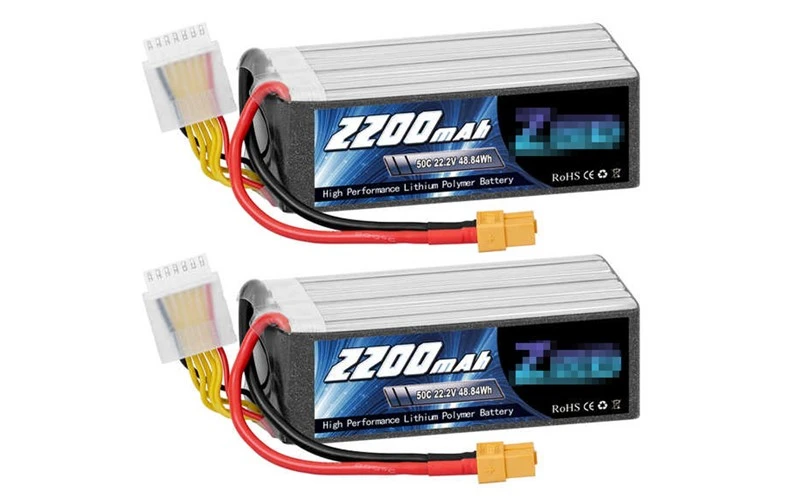
FPV batteries are high-energy-density components, not ordinary accessories. The rules below do not change with frame size, but the larger packs on a 7-inch widen the risk exposure.
Charge with a dedicated balance charger at 1C-1300mAh pack means 1.3A. Some packs tolerate higher rates, but 1C is the long-term safe standard. Charge in a LiPo-safe bag on a non-flammable surface, ceramic or metal, and never leave it unattended. Never exceed 4.2V/cell; LiHV goes to 4.35V but requires a LiHV-capable charger. After a crash, let a warm pack cool to room temperature before charging; heat during charging is an abnormal signal.
For discharge, do not take LiPo below 3.5V/cell under load or 3.7V/cell at rest. Li-Ion is safe down to 2.8–3.0V/cell, but do not impose LiPo cutoffs on Li-Ion, or vice versa. Monitor with OSD or a low-voltage alarm-not by feel. For storage, keep LiPo at 3.80–3.85V/cell and Li-Ion at 3.60–3.70V/cell, cool and dry, away from heat and direct sun; long-term full-charge or empty storage accelerates degradation.
After a crash, puffing, smell, or voltage anomalies mean stop immediately. Do not charge, install, puncture, or disassemble; isolate in a fire-resistant container away from combustibles. Looking fine does not mean undamaged.
Final Verdict
Choose 3.5-inch if you want the lowest crash cost, maximum portability, and minimum registration paperwork, and you accept its clear ceiling on wind and payload. But check your local sub-250g rules first-in the US, recreational sub-250g is registration-free while commercial use is not; in China, sub-250g still requires UOM registration, and micro drones are capped at 50m.
Choose 5-inch if you want the default do-everything platform: ubiquitous parts, affordable repairs, coverage from freestyle to cinematic to racing. But "default" is not "right for everyone": confirm you have legal open space, and treat noise and public perception as real constraints, not other people being "too sensitive."
Choose 7-inch if you live near mountains, coastline, or vast open terrain, your goal is distance cruising and stable endurance, and you have budgeted not just for the purchase but for the crash. Buying a 7-inch only for "long flight time" is the most common mismatch.
Frame size does not determine whether you fly well. Your local rules, the site you actually have, and the crash budget you can actually afford decide which sizes are even available to you-then flying style decides which one to buy.
FAQ
Q: Which FPV frame size is best for beginners?
A: The 3.5-inch micro quad frame is the top pick for new pilots. It has low crash kinetic energy, cheaper spare parts, and lighter weight, making it easier to repair. But check your local drone regulations first, as sub-250g does not always mean registration-free.
Q: Can a 7-inch FPV drone carry a GoPro camera?
A: Yes. The 7-inch long-range FPV frame is structurally designed to support full-size GoPro payloads, while maintaining stable flight and good wind resistance. Note that crash repair costs are much higher than 5-inch models.
Q: Is sub-250g FPV drone completely exempt from drone registration?
A: No. The 250g threshold varies by country. In China, even sub-250g micro drones require UOM registration. In the US, only recreational sub-250g flights skip registration; commercial flights still need full compliance. Airspace restrictions still apply for all sizes.
Q: What is the main downside of a 7-inch long-range FPV frame?
A: High crash cost is the biggest drawback. Larger weight creates high kinetic energy. A single crash may damage motors, props, camera and frame together. It also requires large open flying sites, it is not suitable for tight space freestyle tricks.
Q: Can I use 5-inch FPV frame for long-range flight?
A: It can do short-distance cruising, but not match the endurance and wind resistance of a dedicated 7-inch long-range frame. 5-inch frames are optimized for freestyle and cinematic flying instead of ultra-long endurance missions.
Q: What battery safety rules apply to large FPV quad frames?
A: Always use 1C charging rate, charge inside LiPo safe bag on non-flammable surfaces. Do not discharge LiPo cells below 3.5V/cell. After crashes, inspect battery for swelling, weird smell or abnormal voltage; stop use immediately if damaged.