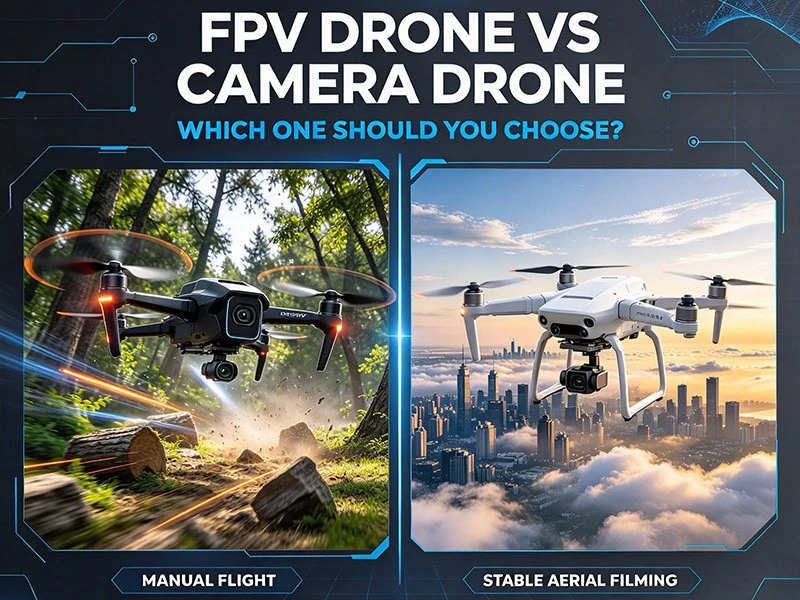
FPV drones and camera drones are both capable of capturing stunning aerial footage, but they are designed for fundamentally different flying experiences. FPV drones offer immersive, first-person flight with direct manual control and extensive customization, while camera drones like DJI's focus on stable footage, intelligent flight modes, and ease of use.
If you are considering buying your first drone, upgrading your aerial filming equipment, or building a custom FPV quadcopter, understanding these differences will help you make the right choice.
In this guide, we will compare FPV drones and camera drones in terms of flight experience, camera performance, control systems, flight time, customization, cost, regulations, and practical applications.
1. What Is an FPV Drone?
An FPV (First Person View) drone allows pilots to see the flight from the drone's perspective through goggles or a screen. With a compatible FPV system, the pilot receives a live video feed from a camera mounted on the aircraft.
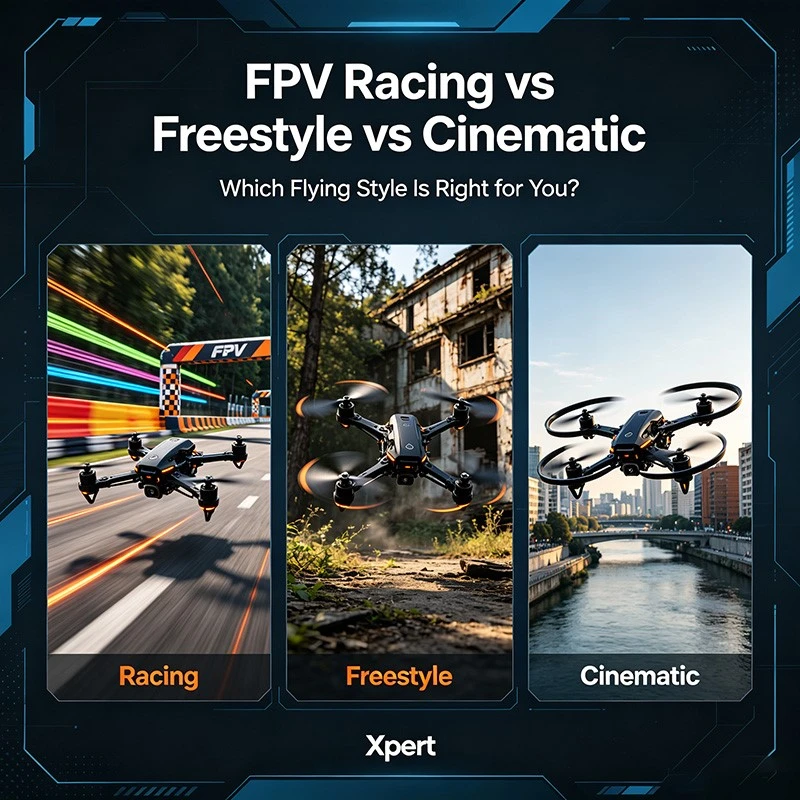
FPV drones are known for their responsive controls, agile flight characteristics, and ability to perform dynamic maneuvers. Depending on the configuration, they can be used for freestyle flying, racing, cinematic filming, and long-range exploration. The term "FPV" was first popularized in the 2010s, with many hobbyists repurposing parts to build their own drones. Since then, the hobby has grown enormously, and companies now produce pre-built drones and electronics for both builders and ready-to-fly users.
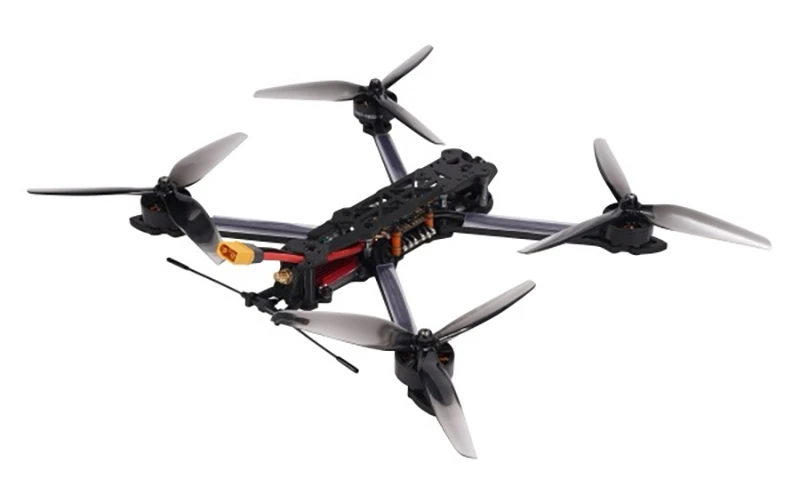
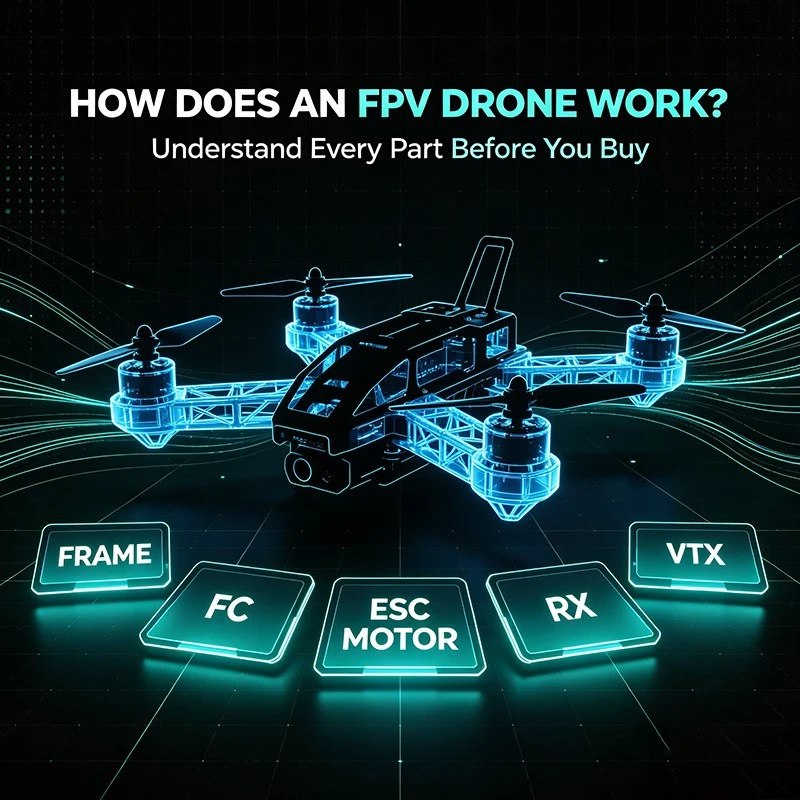
Most traditional FPV quadcopters consist of several key components:
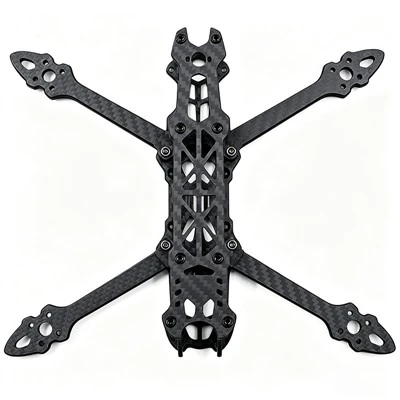
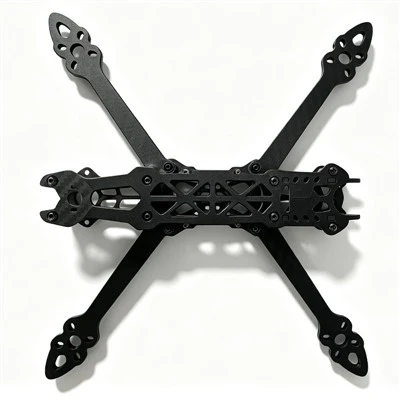
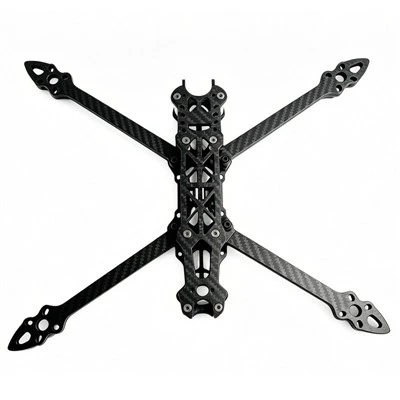
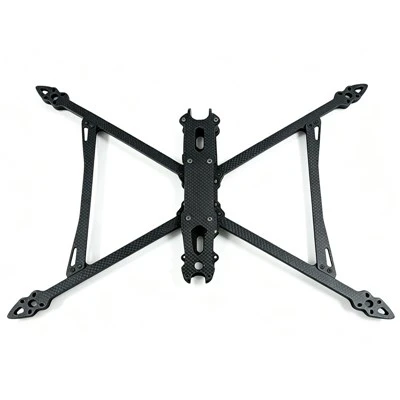
Frame : Supports the motors, electronics, and other components. Carbon fiber is widely used because of its high stiffness-to-weight ratio.
Motors : Provide the thrust required for acceleration, hovering, and maneuvering.
Flight controller : Processes sensor data and pilot inputs to stabilize and control the drone.
ESC (Electronic Speed Controller) : Regulates motor speed in response to flight-controller commands.
FPV camera and video transmitter : Capture and transmit live video to the pilot.
Battery : Supplies electrical power to the propulsion and electronic systems.
Radio receiver and transmitter : Allow the pilot to control the aircraft.
One of the biggest advantages of FPV drones is their flexibility. Pilots can select different frame sizes, motors, propellers, batteries, and video systems to suit their intended applications. FPV requires more tinkering with software and hardware, but these drones can perform much more daunting flights and are designed for acrobatic flying that goes beyond the typical camera drone.
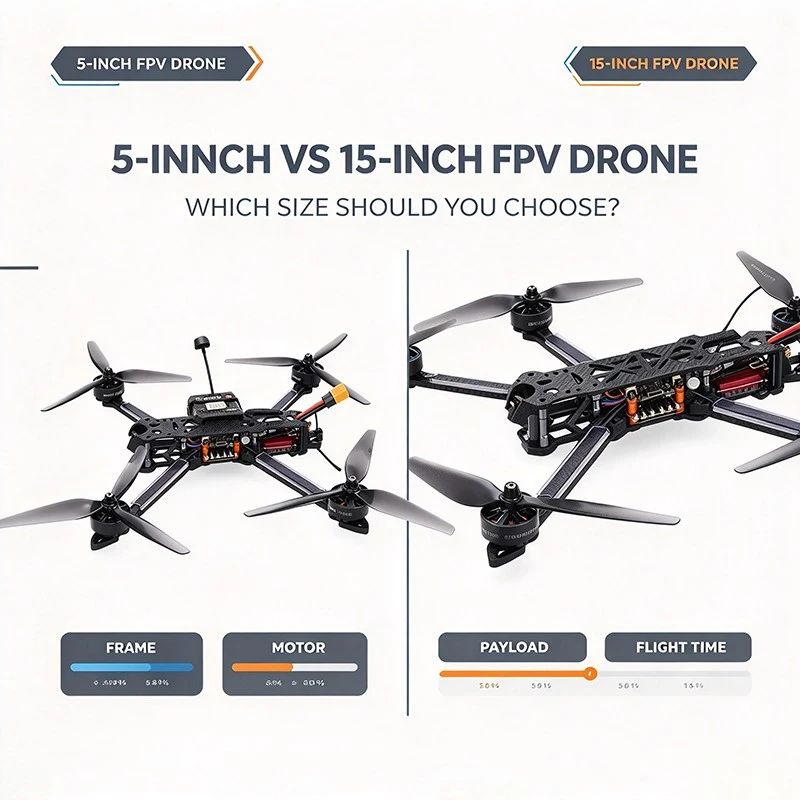
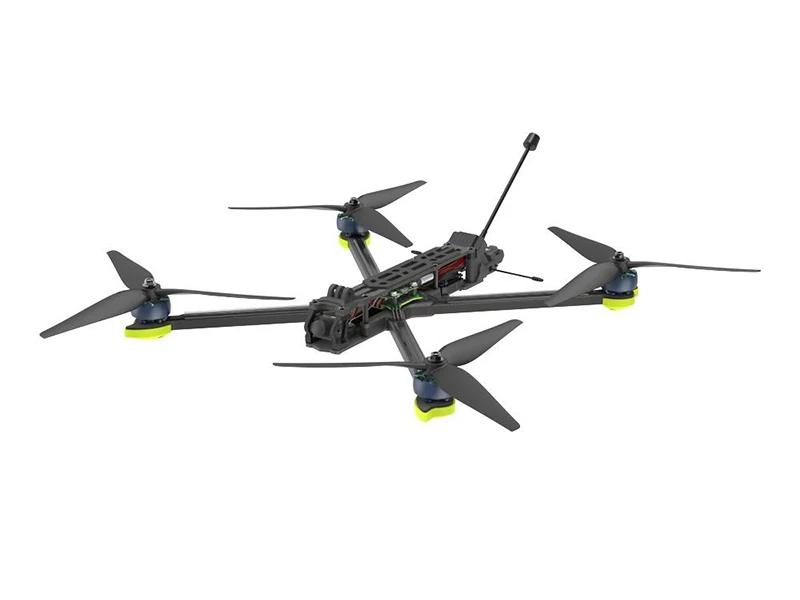
For example, a 5-inch FPV drone is commonly used for freestyle flying and racing, while larger 7-inch, 10-inch, and 15-inch platforms can be configured for different long-range, endurance, or payload-oriented applications. Actual performance depends on the complete build rather than propeller size alone.
2. What Is a Camera Drone?
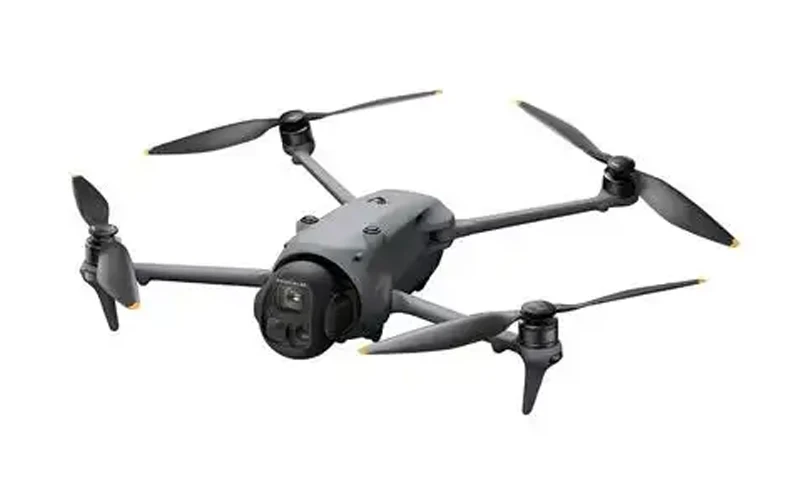
Camera drones - including DJI's consumer lineup - are integrated aerial platforms designed primarily for convenient flight and high-quality photography or videography. Many consumer models combine a stabilized camera, flight controller, navigation sensors, obstacle sensing, and intelligent flight software in one ready-to-fly system.
Unlike a typical DIY FPV build, a DJI camera drone usually requires little assembly. Users can prepare the aircraft, connect the controller, complete the required setup, and begin flying. Most DJI drones are considered "camera drones," which generally means they are equipped with high-quality onboard cameras and are very intuitive to control.
Common features include:
Three-axis mechanical camera stabilization on many models.
GPS-assisted positioning and return-to-home functions.
Intelligent flight modes for automated camera movements.
Obstacle sensing and avoidance on supported models.
Automatic exposure, tracking, and other camera features, depending on the model.
Integrated flight and camera controls designed for a streamlined user experience.
These features make DJI camera drones particularly useful for travel photography, real estate videos, landscape footage, inspections, and general aerial content creation.
However, DJI products vary considerably. Some models emphasize portability, others prioritize professional imaging, and DJI's Avata series offers a more immersive FPV-style experience.
It is important to distinguish conventional camera drones from DJI's FPV-oriented products when making a comparison.
3. FPV Drone vs. Camera Drone: Key Differences
The most important difference is the intended flying experience. FPV drones generally prioritize direct pilot control and maneuverability, while conventional camera drones prioritize stable aerial imaging and automated assistance.
| Feature | Traditional FPV Drone | Camera Drone (e.g., DJI) |
|---|---|---|
| Primary purpose | Racing, freestyle, immersive flight, custom filming | Photography, video, travel, inspections |
| Flight experience | Direct, responsive, and immersive | Smooth, assisted, and accessible |
| Camera stabilization | Depends on camera, mount, and software | Usually an integrated stabilized gimbal |
| Ease of use | Requires more setup and practice | Generally easier for beginners |
| Customization | Extensive on DIY platforms | More limited on integrated consumer models |
| Repairs | Individual components can often be replaced | May require specialized parts or service |
| Flight time | Varies widely with build and flying style | 34–45 min (e.g., DJI Mini 4 Pro)- |
| Intelligent features | Depend on hardware and software configuration | Often includes GPS and automated flight features |
| Learning curve | Relatively steep | Generally more gradual |
| Best suited for | Pilots seeking control, agility, and customization | Users seeking reliable, convenient aerial footage |
Neither category is universally better. The right option depends on what you want to accomplish.
4. Flight Experience: Manual Control vs. Assisted Flying
FPV Drones: More Direct Control
Traditional FPV drones are designed to respond closely to the pilot's control inputs. In Acro mode, the pilot controls rotational rates rather than relying on the flight controller to maintain a level attitude.
This gives experienced pilots the freedom to perform rolls, flips, power loops, dives, and other dynamic maneuvers. As one FPV community member put it, if you buy the right kit you can stay in the sky for 10–15 minutes, but "FPV is not camera drones" - you can build something that resembles a camera drone, but you won't have the same capabilities without spending a lot of money.
FPV flying also creates a more immersive experience. When wearing FPV goggles, pilots see the live camera feed from the aircraft's perspective, making the flight feel more immediate.
However, Acro mode has a learning curve. Beginners should consider practicing in an FPV simulator before flying outdoors. Common simulator options include Flyra, which offers racing, challenges, and freestyle modes with built-in tutorials that progress from stable cinematic flight to full Acro control. Learning to control FPV drones can take months to years to master.
Camera Drones: Stability and Assistance
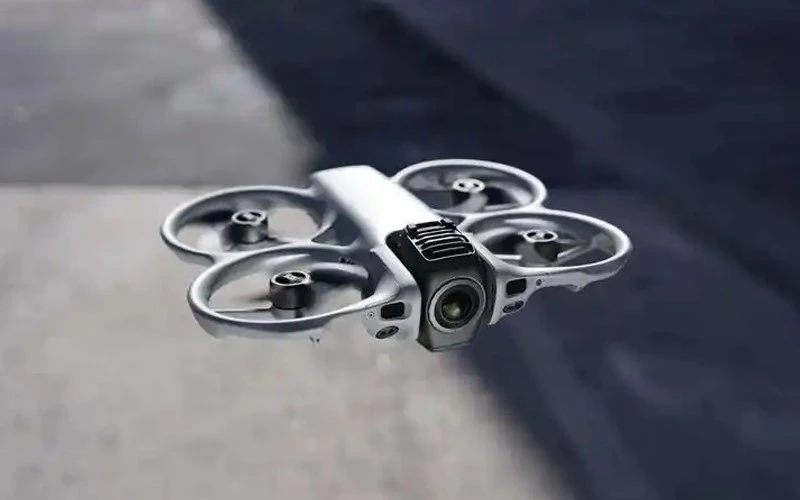
Conventional camera drones are designed to simplify flight. GPS positioning, altitude control, stabilized camera systems, and automated flight functions help users capture footage without mastering advanced manual techniques.
When the pilot releases the controls, a supported GPS-equipped model can typically maintain its position under suitable conditions. DJI drones are easy to learn to control and master, thanks to the use of advanced sensors that can hold their position, avoid obstacles, or fly back to where they took off.
This makes camera drones especially practical for beginners and content creators who want to concentrate on composition rather than complex flight maneuvers.
Which is better?
Choose an FPV drone if you want to develop precise manual flying skills and perform dynamic movements. Choose a conventional camera drone if stable positioning and straightforward operation are more important.
5. Camera Quality: Which Drone Takes Better Videos?
Camera quality is not determined by the drone category alone. Sensor size, lens quality, resolution, dynamic range, stabilization, and recording settings all affect the final result.
Camera Drones: Designed for Consistent Footage
Conventional camera drones typically combine a dedicated imaging system with mechanical gimbal stabilization. For example, the DJI Mini 4 Pro features a 1/1.3-inch CMOS sensor with 48MP effective pixels, capturing 4K video at up to 100fps with HDR support, and omnidirectional obstacle sensing.
This combination helps produce smooth footage during normal aerial movements. Automated exposure and camera settings can also simplify the process of capturing consistent images. For travel videos, landscapes, property marketing, and professional aerial photography, this integrated approach is a major advantage.
FPV Drones: Designed for Dynamic Perspectives
Traditional FPV drones often use a low-latency FPV camera for piloting. Depending on the setup, they may also carry a separate action camera or a lightweight onboard recording camera.
This allows pilots to capture low-altitude tracking shots, fast passes, tight turns, and movements that are difficult to reproduce with conventional camera drones.
However, standard FPV cameras are usually designed for piloting rather than high-quality cinematic recording. Footage may contain vibration, rolling-shutter artifacts, or rapid changes in orientation. An action camera, suitable mounting system, and post-production stabilization can improve the final result. The additional camera also increases weight and power consumption.
For professional productions, dedicated "Cinelifter" platforms can carry cinema-grade cameras for raw footage suitable for cinematic color grading. When a director needs an FPV shot tracking a stunt car at high speed with a cinema camera recording raw footage, a Cinelifter is the only tool for the job.
The bottom line: Camera drones are generally the more convenient option for stable, polished aerial footage. FPV drones are often the better option for immersive, fast-moving, and highly dynamic perspectives.
6. Flight Time and Range
Flight time and range depend on the drone's design, battery capacity, weight, propulsion efficiency, signal system, weather, and flight style.
Flight Time
Conventional camera drones are often optimized for efficient flight and stable aerial photography. Manufacturers publish model-specific maximum flight times, typically measured under controlled conditions. The DJI Mini 4 Pro, for instance, offers up to 34 minutes with the standard battery or 45 minutes with the Intelligent Flight Battery Plus.
Aggressive acceleration, high throttle, heavy cameras, and oversized payloads can reduce flight time substantially.
Larger propellers may improve propulsion efficiency in a suitable design, but a larger frame does not automatically guarantee longer flight time.
Flight Range
Both FPV drones and camera drones depend on their communication systems, antennas, operating environment, and applicable regulations.
Some FPV systems prioritize low-latency video, while others are configured for longer-distance flight. Analog FPV video transmitters provide extremely low latency (under 1 ms glass-to-glass), which is critical for racing and high-speed flying, but at lower image quality. Digital systems like DJI's O3/O4 Pro offer 1080p+ resolution with approximately 30–50 ms latency. HDZero provides digital transmission with sub-4 ms latency, bridging the gap between analog responsiveness and digital quality.
Published transmission distances should not be interpreted as guaranteed real-world flight distances. Interference, obstructions, antenna orientation, and local regulations can all affect practical range.
For either type of aircraft, pilots should maintain an appropriate safety margin and comply with visual-line-of-sight requirements and other applicable rules.
7. Customization and Repairability
Customization is one of the clearest advantages of traditional FPV drones. The modular approach to building and repairing is a core part of the FPV hobby's appeal.
FPV Drones: Build Around Your Needs
Many FPV quadcopters use modular components that can be selected and replaced individually.For example, a pilot can choose:
A 5-inch carbon fiber frame for freestyle flying.
A 7-inch frame for a different balance of cruising efficiency and maneuverability.
A larger frame for a carefully engineered long-range or payload-oriented build.
Motors with an appropriate stator size and KV rating.
Propellers matched to the motors and intended flight characteristics.
A flight controller and ESC compatible with the power system.
A battery configuration suited to the voltage requirements, current demand, and desired endurance.
This modular approach allows pilots to tune performance and repair damaged components without necessarily replacing the entire aircraft. FPV frames, flight controllers, motors, and other parts benefit from a thriving open-source community with tools like Betaflight and INAV, plus hundreds of options for every component.
Carbon fiber is a popular frame material because it offers high stiffness at relatively low weight. Nevertheless, frame design, laminate quality, arm geometry, fasteners, and impact conditions all affect durability.
Camera Drones: Convenience Over Component-Level Customization
Camera drones integrate many components into a compact platform. This reduces assembly work and simplifies the user experience. The trade-off is that users generally have fewer options for changing the propulsion system, frame geometry, or internal electronics.
With an integrated platform like the DJI Avata 2, you get a tight, polished experience where everything works together from the first power-on, but you're locked into DJI's decisions about performance, tuning, and hardware. You can't swap motors, change the frame geometry, or tune PIDs.
Repairs can also be more model-specific, and damage to an integrated camera or gimbal may require specialized service.
If you enjoy designing, assembling, testing, and upgrading aircraft, a modular FPV platform may be more rewarding. If you prefer a ready-to-fly system, an integrated camera drone is usually more convenient.
8. Cost: Which Is More Affordable?
There is no universal price winner. Costs depend on the aircraft, equipment, spare parts, and how much of the system you already own.
FPV Drone Cost Breakdown
A typical FPV build breaks down into six core cost centers. Here are May 2026 prices from major FPV retailers:
| Component | Budget Build | Mid-Range | Premium |
|---|---|---|---|
| Frame | $25–35 | $45–65 | $90–120 |
| Flight Stack (FC+ESC) | $55–70 | $85–110 | $140–180 |
| Motors (4x) | $40–55 | $65–85 | $100–140 |
| VTX | $18–30 | $35–50 | $55–80 |
| Camera | $18–25 | $30–45 | $50–70 |
| Receiver | $13–20 | $20–30 | $35–50 |
| Total (parts only) | $170–235 | $280–380 | $470–640 |
These are component-only totals - add $30–50 for props, batteries, straps, and hardware. A complete FPV racing setup including goggles, radio, batteries, and charger typically totals $650–850.
For a fair comparison, calculate the cost of the complete system rather than the aircraft alone. An FPV setup may require a radio transmitter, goggles, batteries, a charger, spare propellers, soldering equipment, and a simulator. Some of these items can be reused across multiple compatible builds.
Camera Drone Cost
A DJI camera drone package may include more of the essential equipment, although accessories, replacement batteries, and repair services can increase the total cost. For example, the DJI Avata 2 Fly More Combo and the DJI FPV Combo are both priced at approximately $999.
For a fair comparison, consider total ownership cost over the first year: aircraft + batteries + repairs + accessories + any required training or certification.
9. Regulations and Safety
Drone regulations apply to both FPV drones and camera drones. Understanding and complying with local rules is essential regardless of which type you choose.
United States: FAA Rules
In the U.S., the FAA's Part 107 rules cover small unmanned aircraft systems weighing less than 55 pounds. Key requirements include:
Maximum altitude: 400 feet above ground level (higher if within 400 feet of a structure).
Visual line of sight: The drone must be kept within sight at all times. If using FPV goggles, a visual observer must maintain unaided line of sight - FPV goggles alone do not satisfy this requirement.
Maximum speed: 100 mph (87 knots).
Daylight operations: Daylight or civil twilight (30 minutes before sunrise to 30 minutes after sunset). Night operations are permitted with anti-collision lighting visible for at least 3 statute miles.
Registration: Any drone weighing more than 250 grams must be registered with the FAA ($5, valid for 3 years).
Remote ID: All drones requiring registration must comply with Remote ID requirements. For custom FPV builds, a broadcast module ($30–$200) is the most practical solution.
TRUST Certificate: Every recreational pilot must complete The Recreational UAS Safety Test (TRUST), a free online test covering basic safety and airspace rules.
Commercial Use
If you monetize your drone flights in any way - including YouTube ad revenue from flight footage or using drone footage in a monetized social media post - you need a Part 107 Remote Pilot Certificate instead of just TRUST. The FAA has clarified that "furtherance of a business" is interpreted broadly.
Safety Considerations
For FPV drones specifically:
LiPo batteries should be charged at 1C rate in a fire-resistant container, stored at 3.80–3.85V per cell, and never discharged below 3.5V per cell under load.
A sub-250g quad avoids Remote ID requirements, which is a practical consideration for recreational FPV pilots.
FPV drones typically lack obstacle avoidance and have powerful motors with sharp propellers - fly in open, unpopulated areas.
10. Which Drone Is Best for Different Applications?
The best drone depends on the type of footage or flying experience you want.
Choose an FPV Drone If You Want To
- Perform freestyle tricks and racing maneuvers.
- Capture fast, immersive tracking shots.
- Fly through challenging spaces where the aircraft's size and configuration are suitable.
- Build and customize your own aircraft.
- Experiment with motors, propellers, flight controllers, and batteries.
- Develop advanced manual flying skills.
- Capture cinematic FPV footage for film and commercial productions.
Choose a Camera Drone If You Want To
- Capture smooth travel and landscape footage.
- Photograph buildings, properties, and outdoor locations.
- Create aerial content with minimal assembly.
- Use GPS-assisted flight and supported intelligent camera modes.
- Spend less time configuring hardware.
- Focus on photography rather than building and tuning the aircraft.
What About DJI Avata?
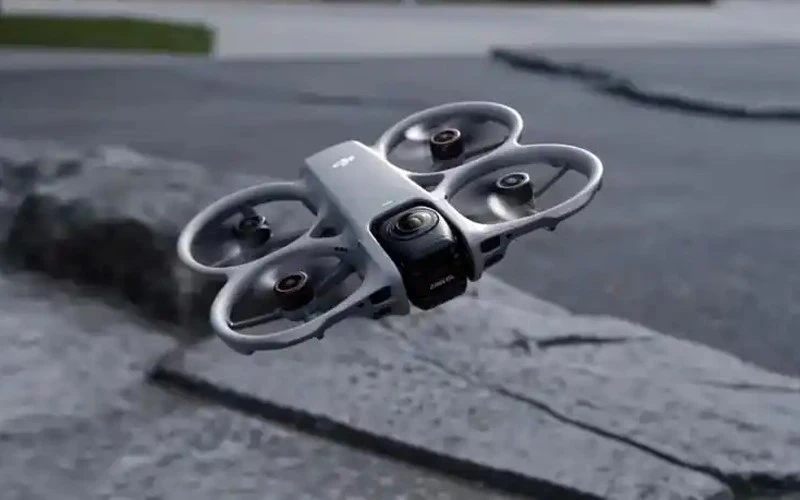
DJI Avata and Avata 2 are worth considering if you want an FPV-style experience without building a traditional DIY quadcopter. The Avata line is made for shooting cinematic FPV footage, with a 1/1.3-inch CMOS sensor shooting 4K/60fps with 10-bit D-Log M color mode, and 155° super-wide FOV. RockSteady 3.0+ and HorizonSteady stabilization produce smooth, usable footage straight out of the drone - no GoPro needed.
It combines an integrated aircraft with a compatible video and control ecosystem. However, an integrated FPV aircraft is not identical to a traditional modular FPV quadcopter. Component-level customization, repair options, and flight characteristics differ. The Avata 2 approach is integrated and consumer-focused - you get a tight, polished experience, but you're locked into DJI's hardware decisions.
11. How to Choose the Right Drone for You
Before buying, answer these five questions:
For smooth aerial photography, start with a conventional camera drone. For freestyle, racing, or immersive manual flight, consider FPV.
Beginners who want to film immediately may prefer a camera drone. New FPV pilots should budget time for simulator practice and learning safe flight procedures.
If you enjoy selecting components and understanding how the propulsion and control systems work, a modular FPV drone offers more flexibility.
Existing goggles, radio transmitters, chargers, batteries, and action cameras may influence the overall cost, provided they are compatible with your intended setup.
Consider the space available, noise, nearby people, obstacles, local airspace rules, and applicable flight restrictions before choosing a drone. A smaller aircraft is not automatically safer or legal in every situation, and long-range capability does not remove the need to follow applicable regulations.
Conclusion
FPV drones and conventional camera drones serve different purposes.
FPV drones stand out for immersive flight, manual control, maneuverability, and component-level customization. They are especially appealing to pilots who enjoy building aircraft, experimenting with configurations, and capturing dynamic footage. The FPV hobby offers a thriving open-source community, diverse hardware options, and the ability to repair and upgrade every component.
Camera drones excel at convenient operation, stabilized imaging, and automated flight assistance. They are often the more practical choice for beginners, travel photography, and consistent aerial video production. With flight times of 34–45 minutes on models like the DJI Mini 4 Pro, they offer significantly longer endurance than typical FPV builds.
If you want to capture smooth footage with minimal setup, a conventional camera drone is a strong starting point. If you want a more hands-on flying experience with extensive customization options, a traditional FPV drone may be the better fit.
Ultimately, the best drone is the one that matches your skills, budget, creative goals, and intended flying environment.
Ready to build your own FPV drone? Start by choosing a frame that matches your intended propeller size and application, then select compatible motors, an ESC, a flight controller, propellers, and a suitable battery. A well-planned build is the foundation of a reliable and enjoyable FPV flying experience.
FAQ
Q: Is an FPV drone better than a camera drone?
A: Neither is universally better. FPV drones are generally better suited to manual freestyle flying, racing, and dynamic camera movements. Conventional camera drones are generally better suited to stabilized aerial photography and convenient operation.
Q: Can FPV drones take cinematic videos?
A: Yes. FPV drones can capture cinematic footage, especially when equipped with a suitable onboard recording camera and carefully configured for the shot. They require more attention to flight control, vibration management, and post-production than many conventional camera drones. For professional productions, dedicated Cinelifter platforms can carry cinema-grade cameras for raw footage suitable for cinematic color grading.
Q: Are FPV drones harder to fly than camera drones?
A: Traditional FPV drones are generally harder to master, particularly in Acro mode. Conventional camera drones provide more flight assistance, making them easier for many beginners to operate. Learning to control FPV drones can take months to years to master.
Q: How long can an FPV drone fly?
A: Flight time varies with frame size, battery capacity, propulsion efficiency, aircraft weight, and flight style. Typically, FPV drones achieve 10–15 minutes with the right setup, while aggressive freestyle flying generally consumes more energy than gentle cruising. Always consult realistic test data for the specific build rather than relying on frame size alone.
Q: Can I use a DJI camera on an FPV drone?
A: Some DJI camera and video systems can be integrated into compatible FPV platforms, but compatibility depends on the specific hardware and intended function. A DJI action camera, a DJI FPV video system (like O3 or O4 Pro), and a conventional DJI camera-drone gimbal are different products and should not be assumed to be interchangeable.
Q: Which is better for long-range flying: FPV or camera drone?
A: Both can support longer-distance operations when properly configured, but they differ in control systems, video transmission, endurance, and intended use. The best choice depends on the aircraft, available equipment, local regulations, and the safety requirements of the flight. Note that long-range FPV flying requires maintaining visual line of sight in most jurisdictions, which limits practical range for recreational pilots.