The FPV video system market in 2026 is more diverse than ever before. Pilots can choose from five different ecosystems: the enduring analog systems, DJI's flagship O4 digital system, Walksnail's versatile platform, HDZero's racing-optimized system, and the emerging open-source solution OpenIPC. Each system has fundamentally different trade-offs in terms of image quality, latency, range, and cost. This article will provide a detailed breakdown of each system to help you make the right choice based on your flying style and budget.
I. First understand the core concept

What is an FPV system?An FPV (First-Person View) system allows you to transmit real-time video to FPV goggles via a camera mounted on the drone, simulating the immersive experience of sitting inside the aircraft's cockpit. An FPV system includes a camera, a video transmitter (VTX), and FPV goggles with a built-in receiver.
Analog vs Digital:The analog system transmits raw composite video signals, which have extremely low latency but limited image quality; the digital system encodes the video into digital signals before transmission, significantly improving image quality, but introducing encoding and decoding latency. The core difference between the two lies in their performance when the signal is lost: the analog image will gradually develop snow noise, providing continuous link quality feedback to the pilot; the digital system, on the other hand, may directly freeze the image or go to a black screen when the signal is suddenly interrupted. For long-distance flights, the progressive attenuation of the analog signal is actually a safety feature.
Overview of Key Indicator Comparison:
| System | Resolution | Latency (glass-to-glass) | Delay type | Penetration ability | Full set price |
| Simulation | 480p–720p | <5ms | Fixed | Best (Progressive Decay) | $150–300 |
| HDZero | 720p–1080p | 8–20ms | Fixed | Good | $500–700 |
| Walksnail Avatar | 1080p | 22–35ms | Variable | Good | $400–600 |
| DJI O4 | 1080p(4K DVR) | 25–38ms | Variable | Best | $600–1200 |
II. Simulation System: The Eternal Mainstay
Analog FPV is the original technology for FPV drones, and to this day, it remains the most widely available and flexible system. A complete analog VTX and camera combo costs only $20-50, far lower than any digital system.
Core advantages:
Ultra-low latency-glass-to-glass latency of less than 5ms, effectively "what you see is what you get", which is the fundamental reason why simulation systems still dominate in racing flight.
Progressive signal attenuation-the screen gradually shows static when the signal weakens instead of suddenly going black, providing a safety guarantee for long-distance flight.
Spectrum sharing-with a simulated channel width of 37MHz, it can simultaneously accommodate 4-6 pilots flying on Raceband channels 1, 3, 5, and 7 without interference.
Zero ecosystem lock--any analog camera is compatible with any analog VTX and goggles module.

Disadvantage:
- Low image quality (usually 600-800 TVL camera, displayed on a 640×480 or 800×600 screen)
- Static noise is severe in high-interference environments.
- No high-quality airborne video
Recommended hardware: RapidFIRE, TBS Fusion receiver module paired with Caddx Ratel 2 or Foxeer T-Rex camera, can produce surprisingly good 720×576 video.
Suitable for: Budget-conscious beginner pilots, racing pilots, Tiny Whoop users, and extreme long-range flyers.
III. DJI O4: King of Image Quality
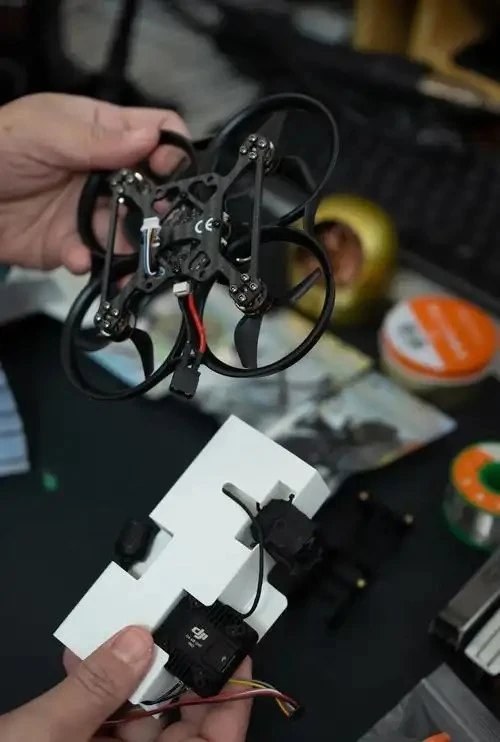
DJI's O4 Pro system (released at the end of 2025) has raised FPV image quality to a new height. Recording at 1080p@100fps and equipped with a 1/1.3-inch sensor, the image quality is close to GoPro's level, and many pilots use it directly to replace standalone action cameras.
Core advantages:
- Unmatched image quality-1080p@100fps real-time transmission, supporting 4K@120fps on-board recording, and 10-bit D-Log M color.
- Industry-leading signal penetration-thanks to OFDM modulation technology, its penetration capability between trees and buildings far exceeds that of its competitors.
- Excellent low-light performance-the 1/1.3-inch sensor performs excellently in twilight and cloudy conditions.
- O4 Air Unit Pro claims a transmission distance of 10km+ under ideal conditions and is equipped with a dual antenna kit.
- The O4 Lite weighs only 8.2g, making it suitable for micro drones.
Disadvantage:
- Highest latency - 22-28ms in low latency mode, 35-40ms in high quality mode
- The ecosystem is completely closed-DJI Goggles can only be paired with DJI Air Units and do not support analog or other digital systems.
- High cost - O4 Pro standalone unit about $230, Goggles 3 about $500, full kit $600-1200
- Racing scenarios are not suitable - variable latency makes it difficult to control precisely in close-range racing.
Regarding the US market: Starting from December 22, 2025, DJI will be included in the FCC Covered List, prohibiting new US equipment authorizations. Previously purchased equipment can still be used legally, but new hardware may be difficult to obtain. The exemption for software and firmware updates has been extended to January 2029.
Suitable for: Cinematic FPV pilots pursuing the highest image quality, freestyle pilots, and long-range flyers.
IV. HDZero: The Top Choice for Racing
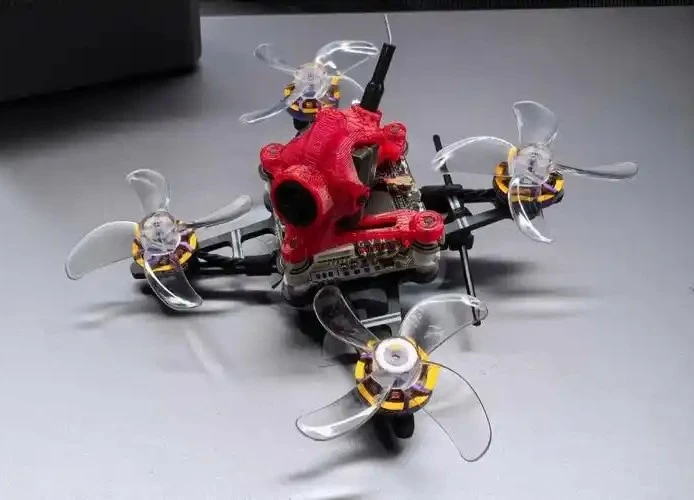
HDZero is jokingly called "Analog+" by the community because it transmits uncompressed raw raster lines without going through a video encoding chip, achieving a fixed ultra-low latency. HDZero has a latency of only 8-10ms at 720p@90fps, and can go as low as 3.5ms in 540p@120fps racing mode.
Core advantages:
- Fixed low latency-regardless of signal quality, the latency remains constant, which is crucial for racing pilots.
- Graceful signal degradation-the appearance of a "pixel blizzard" instead of a frozen frame when the signal weakens, still keeping the underlying structure of the image recognizable.
- HDZero goggles support analog input-one pair of goggles covering two worlds.
- Optional independent VRX module, compatible with third-party HDMI goggles
Disadvantage:
- The image quality is clearly lagging behind-peaking at 720p, it looks noticeably softer than Walksnail's 1080p.
- Penetration capability is average - it uses a simpler transmission solution than DJI and Walksnail, and its wall-penetrating capability is relatively weak.
- The cost-performance ratio is not high in non-racing scenarios-a complete set costs $500-700, which may make it difficult to demonstrate value for non-racing purposes.
Suitable for: Competitive racing pilots, proximity flying pilots, and pilots who need guaranteed fixed latency.
V. Walksnail Avatar: The most balanced DJI alternative

The Walksnail Avatar is widely recognized as the closest competitor to DJI, offering 1080p@100fps image quality and 22-28ms latency, striking a balance between DJI's image quality and HDZero's speed.
Core advantages:
- Strongest ecosystem compatibility - Walksnail goggles support HDMI input and can be paired with analog adapters; HDZero goggles can also receive Walksnail signals through the VRX module.
- The VTX product line is rich-from the 9.5g 1S Nano suitable for Tiny Whoops, to the GT 2W VTX suitable for 5-inch quads, providing comprehensive coverage.
- More affordable price - VTX is about $140, $50 cheaper than DJI
- Goggles X is equipped with dual 1080p OLED displays, a 100Hz refresh rate, and supports head tracking.
- Canvas mode provides a 540p@120fps racing low-latency setting with a latency of about 18ms.
Disadvantage:
- Comprehensive performance but not outstanding-it is not the first in either single comparison of image quality or latency.
- Firmware update pace slows down-update frequency has significantly decreased since 2025.
- Occasional minor firmware issues-the user experience is not as refined as DJI's.
Note: Caddx operates both the Walksnail Avatar and the new Ascent brands simultaneously, and Ascent is completely incompatible with Avatar.
Target Audience: Freestyle pilots, mid-range budget cinematic pilots, and pilots who want a single set of equipment compatible with multiple systems.
VI. Walksnail Ascent: Affordable Digital Entry
Ascent is a brand new budget digital FPV system launched by Caddx, which is completely unrelated to and incompatible with Avatar. The VTX is about $35 and the goggles are about $150, making it the cheapest digital FPV solution on the market currently.
Measured data: approximately 40ms latency at 720p/60fps, approximately 40-45ms at 1080p/60fps, and over 55-60ms on the glasses side.
Real-world review: The image quality is significantly inferior to all mature digital systems, the range is limited, and hardware options are extremely few. Some users reported that the bitrate drops sharply when flying through obstacles, and the 100mW power limit is obvious. Forum users' consensus is that "for those who are already using DJI/Walksnail/HDZero, there is almost no reason to buy it."
Target audience: Pilots with extremely limited budgets, or early adopters curious about new technology. For most users, it is not recommended as a primary system at this stage.
VII. OpenIPC: The Choice of Open Source Geeks
OpenIPC is an open-source firmware project that converts ordinary IP camera hardware into a digital FPV system, using H.265 encoding and the WFB-NG (WiFi Forked Broadcast) protocol to transmit video over a modified WiFi network.
Core advantages:
- Extremely low cost-it only takes a camera costing about $40 and a phone running PixelPilot to get started and work.
- Fully open source - the firmware is completely open on GitHub
- Long-range potential - using high-end WiFi adapters (such as Asus AC-56) and directional antennas, some pilots report distances exceeding 20km.
- Controllable latency - end-to-end latency can be as low as about 30ms on supported hardware

Disadvantage:
- Requires extensive technical configuration-needs WiFi link configuration, firmware flashing, and troubleshooting, making it unsuitable for pilots seeking plug-and-play.
- Low bitrate - typically only about 4Mbps (720p), far lower than DJI/Walksnail's 25-50Mbps, which may cause pixelation in fast-moving scenes.
- Latency varies by platform-dedicated ground stations 26-67ms, mobile phones/tablets 50-100ms, laptops 60-100ms
Target audience: DIY enthusiasts and developers who love tinkering, and are willing to invest time in exchange for open-source flexibility and extremely low costs.
VIII. Artosyn chip system group (BetaFPV ArtLynk, etc.)
In 2026, multiple new systems based on the same Artosyn chipset emerged, including BetaFPV ArtLynk, STARTRC VT5, and Walksnail Ascent. The menus of these systems are highly similar, which may be a universal solution developed by Artosyn and licensed to different brands.
BetaFPV ArtLynk real-world test: The image quality is significantly better than analog, allowing distant objects and branch details to be clearly seen, with a good dynamic range. However, the latency is as high as 67ms (glass-to-glass), which is almost double that of DJI O4 in 100fps mode. The P1 Air Unit weighs only 7.1g, making it very suitable for 75mm Tiny Whoops.
ArtLynk's VR04 HD goggles are about £140, and the P1 Air Unit is about £35, making the total price less than half of the DJI Goggles 3 plus O4 Air Unit. However, the P1 Air Unit does not have an onboard recording function, so all footage can only be recorded via the goggles' DVR, and the recording quality will also drop when the signal weakens.
Suitable for: Cruising, Tiny Whoop indoor flying, fixed-wing FPV, and learning to fly. Not suitable for racing and Bando flying.
IX. Purchasing Advice
Recommended by flight style:
Racing flight → HDZero or analog. HDZero provides fixed low latency, analog provides extremely low latency and the lowest cost.
Cinematic/Freestyle → DJI O4 Pro or Walksnail Avatar. Choose DJI for ultimate image quality, choose Walksnail for balance and compatibility.
Budget entry → Simulation. A full setup under $200 is enough to take off, and simulation will never go out of style.
Tiny Whoop indoor flight → Analog or Walksnail 1S Lite. Analog is the lightest and cheapest, Walksnail provides HD image quality.
Long-range flight → DJI (within the ecosystem) or simulator. DJI provides the longest distance within the ecosystem, and the simulator provides the highest power VTX options.
Technical tinkering/DIY → OpenIPC. Fully open source, requires technical patience.
Advice for beginners:
If the budget is sufficient and you do not care about ecosystem lock-in, DJI is the safest choice for image quality. If the budget is limited, FPV is a very effective starting point-it has low latency, can solidly cultivate control skills, and you can upgrade to a digital system later. FPV will never go out of style, and many pilots still keep their FPV equipment after switching to digital systems.
Special reminder to American pilots:
Due to the FCC Covered List restrictions facing DJI, existing equipment can still be used legally, but acquiring new hardware may become increasingly difficult. Walksnail Avatar is the alternative with image quality and performance closest to DJI. Analog systems remain the safest choice in terms of hardware availability and flexibility.
X. Conclusion
There is no standard answer for choosing an FPV system; the best solution depends on your priorities, flying style, and budget. The 2026 market offers unprecedented diversity: analog remains the king of entry-level and racing, DJI is unrivaled in image quality, HDZero dominates the racing field, Walksnail is the most balanced alternative, while Ascent and OpenIPC represent two different paths to affordable digitalization.
Core principle: Never buy an FPV system based on promises of future improvements. Make decisions based on currently available hardware and performance, rather than marketing hype.
FAQ
Q: Which FPV system is the best to buy in 2026?
A: If budget allows and ecosystem lock-in is acceptable, DJI O4 Pro offers the best image quality, penetration, and overall experience. Walksnail Avatar is the best alternative; HDZero and analog are better for racing; analog is the cheapest way to start.
Q: What is the difference between analog and digital FPV systems?
A: Analog systems have very low latency and low cost, but poor image quality and show static when signal weakens. Digital systems offer HD image quality, but higher latency and may freeze or go black when signal is lost.
Q: Which FPV system is best for beginners?
A: Choose DJI if budget allows; choose analog if budget is limited; choose Walksnail Avatar for a balance of quality and price. Beginners should generally avoid Ascent or OpenIPC as their first system.
Q: Which FPV system is best for racing?
A: HDZero and analog are best for racing because they offer fixed low latency. DJI and Walksnail have variable latency depending on signal, making them less suitable for professional racing.
Q: Which FPV system is best for long-range flying?
A: DJI offers the longest range within its ecosystem and works well out of the box; analog supports high-power VTX for maximum flexibility; HDZero and Walksnail can also fly 10km+, but require proper antennas.
Q: Can I still use DJI FPV in the US in 2026?
A: Existing DJI equipment can still be used legally, but new hardware authorization is restricted, and spare parts may become harder to get. US pilots should consider Walksnail or analog as alternatives.