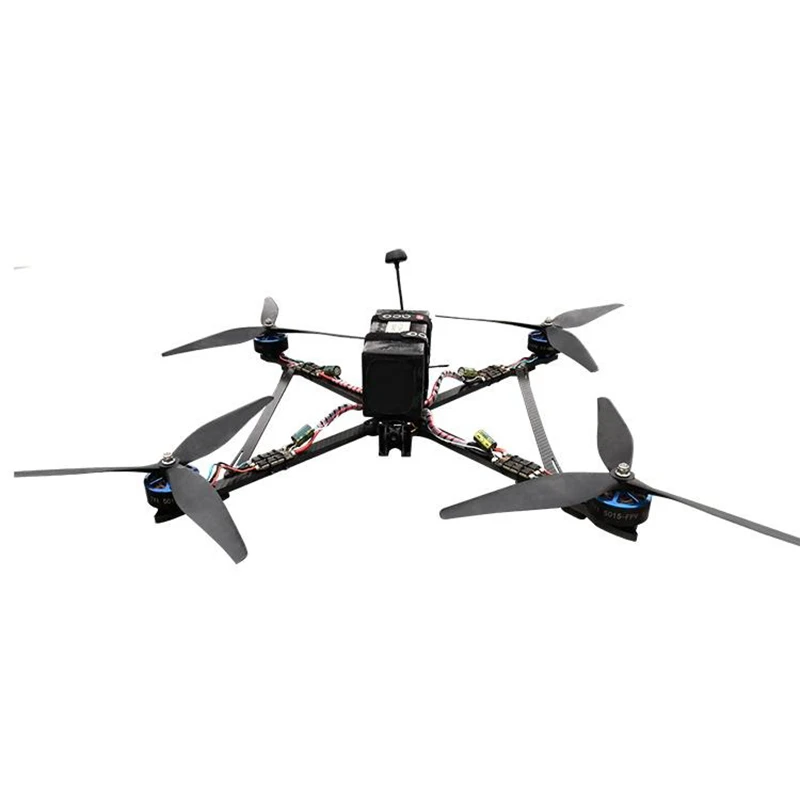
FPV drones come in a wide range of sizes, from compact racing quadcopters to large platforms designed for long-range flights and specialized payload applications. Among these options, 5-inch and 15-inch FPV drones represent two very different approaches to drone design.
A 5-inch FPV drone is widely associated with freestyle flying, racing, and responsive maneuvering. A 15-inch FPV drone, by contrast, offers more space for larger propellers, bigger batteries, and additional equipment, making it suitable for certain long-range and specialized applications.
However, choosing between these two sizes involves more than comparing propeller diameters. Frame geometry, motor characteristics, battery requirements, total weight, and flight performance all play important roles. This guide compares 5-inch and 15-inch FPV drones to help you understand their differences and choose the right platform for your project.
1. Frame Size and Structural Design
The frame is the foundation of an FPV drone. It supports the motors, flight controller, electronic speed controllers (ESCs), battery, camera, and other electronic components. As drone size increases, frame design becomes increasingly important.
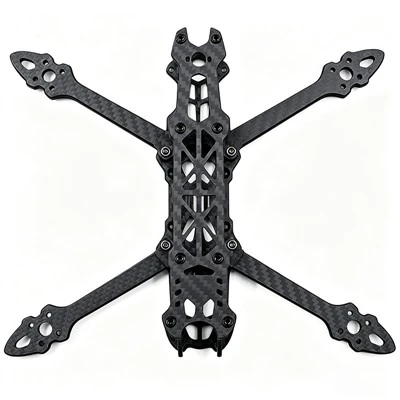
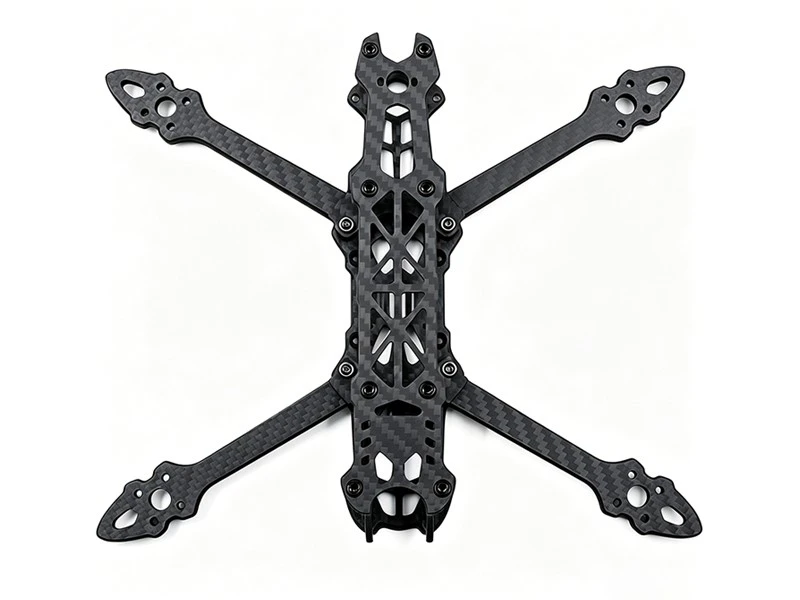
5-inch FPV drone frames
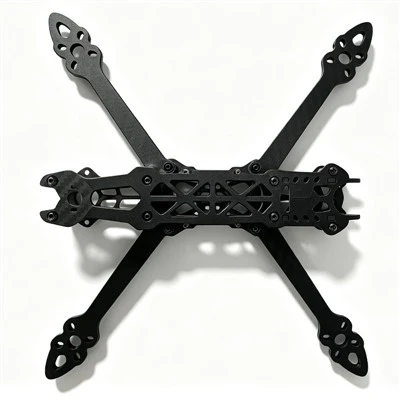
A typical 5-inch FPV drone uses a compact carbon-fiber frame with four arms, a central electronics stack, and mounting points for its motors and camera. Wheelbase typically ranges from 195 mm to 250 mm, with arm thickness of 4–5 mm.
Its relatively small size makes it easier to transport, assemble, and repair. The shorter arms and compact layout also help create a lightweight structure suitable for rapid changes in direction.
Common design priorities include:
- Low frame weight and high stiffness
- Compact electronics mounting
- Durable arms that can withstand crashes
- Compatibility with standard motor, camera, and flight-controller mounting patterns
15-inch FPV drone frames
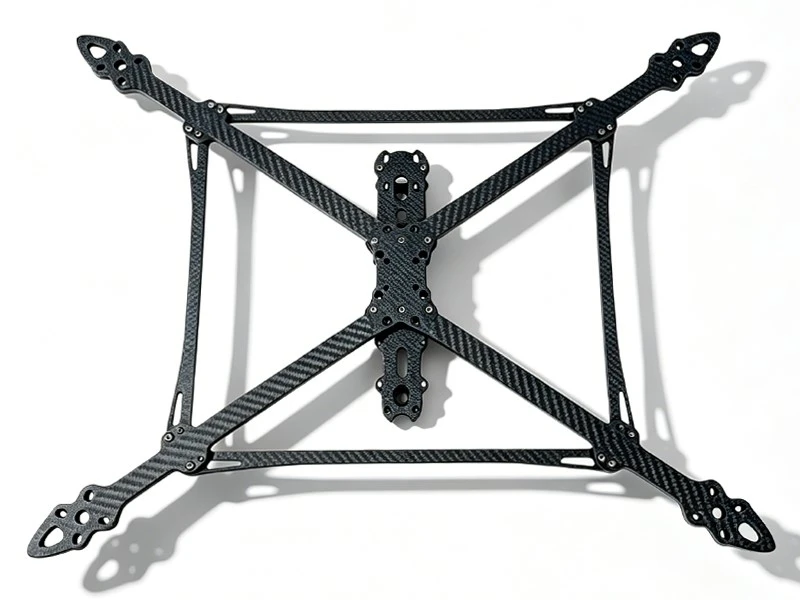
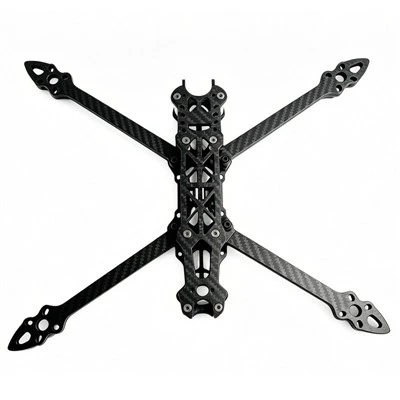
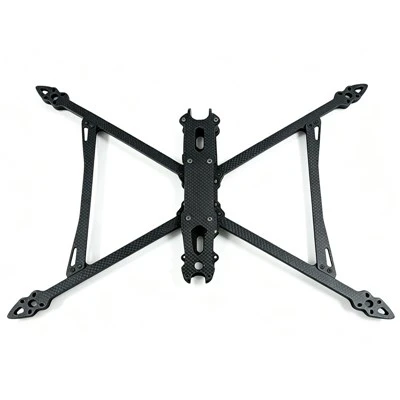
A 15-inch FPV drone requires a substantially larger frame to accommodate its larger propellers and the spacing needed to prevent interference. Wheelbase typically ranges from 580 mm to 680 mm, with arm thickness often reaching 8 mm.
The arms generally need to be longer, and designers must pay close attention to structural stiffness, vibration, and motor mounting strength. The central frame may also require additional space for larger batteries, GPS modules, and payload mounting systems.
Common design priorities include:
- Adequate arm stiffness and resistance to bending
- Reliable motor mounting under operating loads
- Sufficient space for batteries and electronics
- Vibration management and structural durability
- A balance between frame weight and payload capacity
Carbon fiber is widely used for both sizes because of its favorable stiffness-to-weight characteristics. However, a larger frame is not automatically stronger simply because it uses thicker carbon plates. Layup, material quality, arm geometry, fasteners, and structural design all influence performance.
Key takeaway: A 5-inch frame prioritizes compactness and agility, while a 15-inch frame must accommodate larger components and manage the structural demands of a larger propeller system.
2. Motors and Propellers
Motor and propeller selection is one of the most important differences between 5-inch and 15-inch FPV drones. Propeller diameter affects the amount of air a propeller can accelerate and the power required to produce thrust. Larger propellers can move more air at lower rotational speeds under suitable operating conditions, but they also place different demands on the motor and power system.
Motor selection for 5-inch drones
Most 5-inch freestyle and racing drones use 2207 or 2306-size brushless motors with KV ratings between 1700 and 1960 when paired with 6S batteries. A typical freestyle build weighs roughly 380–700 g all-up weight, with motor weight around 30–35 g each.
Common 5-inch motor configurations include:
2207 1750–1900 KV with 6S LiPo and 5-inch tri-blade propellers
2207.5 1850 KV with 4S LiPo for budget builds
2306.5 1900 KV with 6S for high-performance freestyle
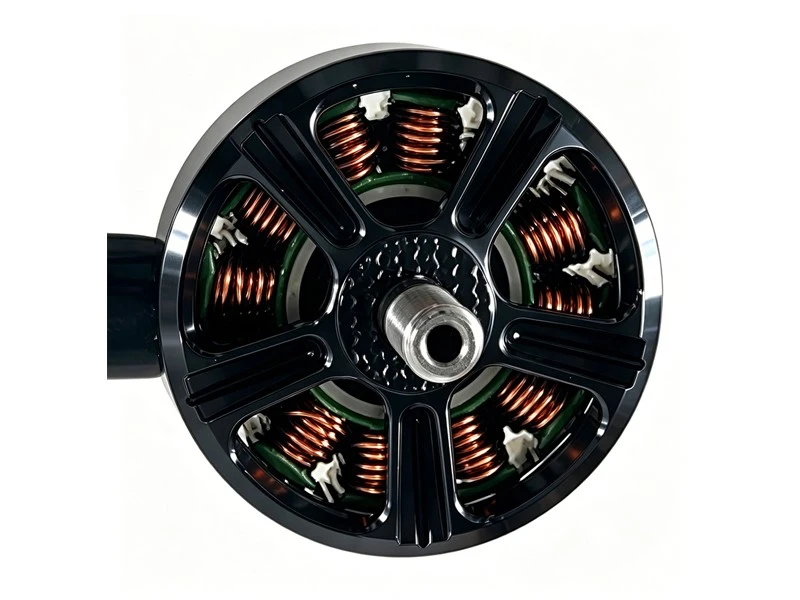
A lightweight freestyle build may prioritize rapid throttle response, while a racing build may prioritize acceleration and predictable handling.
Motor selection for 15-inch drones
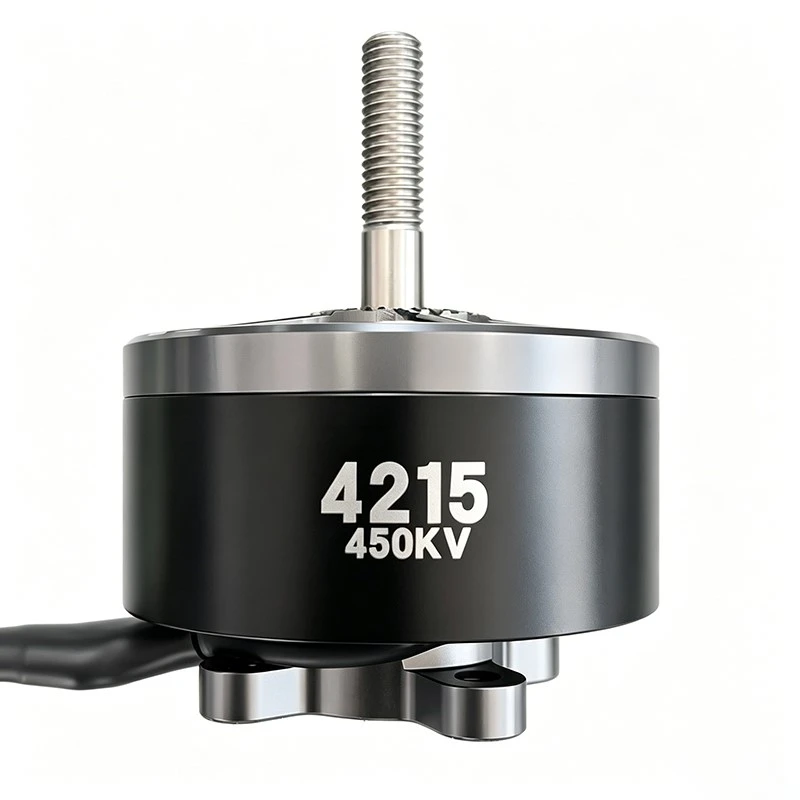
A 15-inch drone generally requires motors capable of driving much larger propellers while producing sufficient torque throughout the operating range. Common motor choices include 4215 and 5215 sizes.
For example, a 4215 450KV motor paired with C15×8×3 propellers and an 8S battery produces approximately 5.64 kg of maximum thrust per motor at full throttle, with a peak power of 1058 W and a peak current of 48.74 A. Recommended takeoff weight for a 15-inch X4 frame with this motor is 12 kg (normal) to 18 kg (maximum).
In a real-world test, an 11 kg takeoff weight (including 5 kg payload) with an 8S 30,000 mAh battery at 100 km/h cruise speed achieved 30 minutes of flight time covering 50 km.
- Important selection factors include:
- Maximum continuous and peak current
- Motor torque and stator dimensions
- Propeller diameter, pitch, and blade count
- Battery voltage and ESC compatibility
- Motor temperature under sustained load
- Total aircraft weight and required thrust
A larger motor may offer the torque needed for a large propeller, but it also adds weight. A 4215 motor weighs approximately 211 g, compared to roughly 33 g for a typical 5-inch motor. The goal is to select a motor-propeller combination that meets the aircraft's thrust and efficiency requirements without unnecessarily increasing mass.
Key takeaway: A 15-inch drone is not simply a 5-inch drone with bigger propellers. Its entire propulsion system must be matched to the larger propeller load and intended operating conditions.
3. Battery Capacity and Flight Time
Battery selection strongly influences the weight, performance, and flight time of an FPV drone.
Battery requirements for 5-inch drones
A 5-inch drone typically uses a 6S LiPo battery with 1100–1550 mAh capacity and a discharge rate of 100–120C. Battery weight is approximately 210–250 g.Typical priorities include:
High current delivery for demanding maneuvers
A manageable battery weight
Fast throttle response
Sufficient energy for the intended flight duration
Flight times for 5-inch drones vary by flying style:
Aggressive freestyle: 3–6 minutes
Cruising or light cinematic: 6–10 minutes
Racing: 2–4 minutes
Battery requirements for 15-inch drones
Larger platforms may use higher-capacity batteries or higher-voltage configurations. For 13–15 inch FPV drones, 8S LiPo (nominal 29.6V) can offer a practical balance between higher voltage headroom, strong discharge performance, and reliable power delivery, provided the motor, ESC, propeller, and payload are properly matched.
Power = Voltage × Current. At the same power demand, higher voltage reduces current, which can reduce resistive losses and allow the use of thinner wiring. However, the motor, propeller, ESC, wiring, connector, and payload must all be designed for that voltage range.
A typical 15-inch setup might use an 8S 30,000 mAh battery. Real-world flight data shows:
-
11 kg takeoff weight (5 kg payload), 8S 30,000 mAh, 100 km/h cruise: 30 min / 50 km
-
18 kg takeoff weight (12 kg payload), 8S 30,000 mAh, 80 km/h cruise: 13 min / 18 km
Battery energy can be estimated as:
Energy (Wh) = Capacity (Ah) × Nominal Voltage (V)
For example, a 6,000 mAh battery at a nominal voltage of 22.2 V contains approximately 133.2 Wh of nominal energy. Actual usable energy depends on the battery chemistry, discharge conditions, voltage limits, temperature, and system efficiency.
Key takeaway: A 15-inch drone may have more room for battery capacity, but longer flight time depends on the efficiency of the complete aircraft rather than size alone. In practice, a 15-inch platform can achieve 25–40 minutes of flight time depending on payload and configuration, compared to 3–10 minutes for a typical 5-inch drone.
4. Flight Characteristics: Agility vs. Momentum
One of the most noticeable differences between 5-inch and 15-inch FPV drones is how they respond to control inputs.
The agility of a 5-inch FPV drone
A typical 5-inch drone is designed for responsive handling. Its relatively compact dimensions and lower mass can make rapid changes in direction easier to achieve. Maximum speeds can reach 150 km/h or more in racing configurations.
This makes the format popular for:
Freestyle flying
FPV racing
Technical maneuvers
Flying through gates and obstacles
Close-range cinematic movements
Actual responsiveness also depends on motor performance, propeller selection, mass distribution, flight-controller tuning, and frame stiffness.
The momentum of a 15-inch FPV drone
A 15-inch drone generally has larger dimensions and may have considerably more mass. Depending on its design, it can feel less nimble during rapid direction changes and require more space for maneuvering. A full-payload 15-inch platform may have a top speed around 85–120 km/h.
Its larger propellers and greater rotational inertia can also affect how quickly the aircraft changes its thrust output.
However, a well-designed large drone can still be stable, controllable, and responsive within its intended flight envelope. Its higher mass actually provides advantages in windy conditions-a heavy long-range platform can cut through turbulent weather more effectively than a lightweight 5-inch quad.
Key takeaway: Choose a 5-inch drone when maneuverability is a priority. Consider a 15-inch drone when the mission benefits from a larger airframe and propulsion system, especially in challenging wind conditions.
5. Payload Capacity and Equipment Integration
Payload capacity is another important consideration when comparing these two drone sizes.A 5-inch drone can carry cameras and accessories, but additional equipment can quickly affect its weight, flight time, and handling. A 15-inch frame may offer more physical space for larger batteries, specialized cameras, sensors, and other equipment.
Payload considerations for 5-inch drones
Typical equipment includes:
FPV cameras and video transmitters
Compact action cameras (e.g., GoPro)
Flight controllers and ESCs
GPS modules and antennas
Small mounting accessories
Keeping the payload lightweight helps preserve the aircraft's responsiveness and performance.
Payload considerations for 15-inch drones
Depending on its design and intended use, a larger platform may accommodate:
Larger imaging equipment (thermal, multispectral)
Additional sensors and LiDAR
Higher-capacity batteries
Specialized mounting hardware
Equipment for industrial or research applications
Real-world examples illustrate the payload capabilities of 15-inch platforms:
A 15-inch heavy-lift platform with a 647 mm wheelbase and 3K carbon fiber frame supports payloads up to 12 kg, achieving 25 minutes of flight time with a light load on a 6S 20,000 mAh battery.
In specialized defense applications, 15-inch FPV platforms have demonstrated the ability to carry up to 8 kg over distances of 30 km, and up to 50 km under favorable conditions.
It is important to distinguish physical space from actual payload capacity. A frame may have enough room for a piece of equipment but lack the thrust, battery capacity, structural strength, or vibration performance needed to carry it safely.
Before selecting a payload, calculate the complete takeoff weight and verify that the motors, propellers, ESCs, battery, and frame are appropriate for the intended load.
Key takeaway: A 15-inch drone can provide more room for equipment, but its actual payload capability must be established through engineering calculations and testing.
6. Cost, Maintenance, and Transportation
The cost of an FPV drone depends on more than its frame size. Electronics, motors, batteries, video systems, and component quality all influence the final budget.
5-inch drones
A complete 5-inch FPV drone kit typically ranges from $200 to $500, depending on component quality. Advantages include:
A broad selection of compatible components
Compact storage and transportation
Generally convenient access to spare parts
Relatively straightforward frame repairs
A large community of builders and pilots
15-inch drones
Large-format builds involve significantly higher component costs. A ready-to-fly 15-inch FPV drone ranges from approximately $300 to $1,200 depending on configuration and payload capability.
Key cost factors for 15-inch builds:
Motors: 4 × $40–$80 (vs. 4 × $15–$25 for 5-inch)
ESCs: $80–$160 for 4-in-1 or individual units
Battery: $80–$200 for high-capacity 8S packs
Frame: $60–$150 for carbon fiber
Propellers: $15–$30 per set
They may also require more space for transportation and maintenance. Frame damage can involve larger or more expensive components. Additionally, troubleshooting vibration or propulsion issues may require more extensive testing.
The total cost should include the complete aircraft, batteries, chargers, spare parts, transportation requirements, and any equipment needed for the intended mission.
Key takeaway: A 5-inch drone is often the more practical choice for everyday hobby flying, while a 15-inch build makes sense when its capabilities justify the additional size and system requirements.
7. Regulations and Safety: What You Must Know Before You Fly
This section is critical and often overlooked. A 15-inch FPV drone will almost always exceed the 250 g threshold that triggers registration and Remote ID requirements in most jurisdictions.
Weight classes and their implications
In China, the regulatory framework established by the Unmanned Aircraft Flight Management Interim Regulations and the 2026 mandatory national standards classifies drones as follows:
-
Micro : Empty weight < 250 g. Max altitude 50 m in permitted airspace. No operator license required for recreational flight.
-
Light : 250 g < empty weight ≤ 4 kg. Max altitude 120 m. Mandatory real-name registration on the UOM platform. Remote ID (broadcast + network) required for new drones manufactured after May 1, 2026.
A 15-inch FPV drone typically falls into the Light category or above, which means:
- Real-name registration on the UOM platform (uom.caac.gov.cn) is mandatory
- Remote ID is required for new aircraft; self-built FPV drones must be fitted with an external RID module and registered on the UOM platform
- Police registration through the local public security platform is also required
- Commercial use requires a CAAC drone pilot license
International considerations
In the United States, the FAA requires registration for any drone over 0.55 lbs (250 g), and Remote ID is mandatory for most aircraft. Recreational pilots must also pass the free TRUST safety test. A visual observer is generally required when flying with goggles, because the pilot's own eyes are not watching the aircraft.
In the European Union, operator registration is required in most member states, with class labels tied to weight and capability.
Practical safety guidelines for 15-inch FPV drones
-
Never fly over people or crowds. A 15-inch drone with spinning propellers and significant mass poses serious injury risk.
-
Always perform pre-flight checks. Verify motor mounting, propeller condition, battery state, and firmware.
-
Use a pre-arm switch and failsafe configuration. A runaway 15-inch drone can cause significant damage.
-
Fly within visual line of sight or use a designated visual observer.
-
Check airspace restrictions before every flight session. Flying near airports, military facilities, or restricted zones is prohibited without authorization.
-
Build experience gradually. Start with a simulator and a smaller training drone before attempting to fly a 15-inch platform.
Key takeaway: A 15-inch FPV drone is not just a bigger toy-it is a regulated aircraft with significant safety responsibilities. Understanding and complying with local regulations is non-negotiable.
8. Which FPV Drone Size Should You Choose?
There is no universally best FPV drone size. The right choice depends on your flying style, equipment requirements, budget, and experience.
| Feature | 5-Inch FPV Drone | 15-Inch FPV Drone |
|---|---|---|
| Typical focus | Freestyle and racing | Larger platforms and specialized missions |
| Wheelbase | 195–250 mm | 580–680 mm |
| All-up weight | 380–700 g | 2–12 kg (depending on payload) |
| Propellers | 5-inch, typically 3-blade | 15-inch, typically 3-blade |
| Motor size | 2207/2306, 1700–1960 KV (6S) | 4214/5215, 280–400 KV (6S–8S) |
| Battery | 6S 1100–1550 mAh LiPo | 6S–8S 10,000–30,000 mAh LiPo |
| Flight time | 3–10 minutes | 15–40 minutes |
| Max speed | 120–150+ km/h | 85–120 km/h |
| Payload capacity | Action camera (100–200 g) | 1–12 kg (depending on configuration) |
| Maneuverability | Highly agile | Less suited to tight maneuvers |
| Wind resistance | Moderate | Excellent |
| Transportation | Fits in a backpack | Requires a large case |
| Cost (RTF) | $200–$500 | $300–$1,200 |
| Regulatory burden | May be exempt if < 250 g | Registration + Remote ID required |
Choose a 5-inch FPV drone if:
You want to learn freestyle flying or racing
1
>>
You prioritize agility and quick control response
2
>>
You need a compact drone that is easy to transport
3
>>
You prefer a broad selection of readily available components
4
>>
You want a versatile platform for everyday FPV flying
5
>>
You want to stay below the 250 g regulatory threshold (with certain lightweight builds)
6
Consider a 15-inch FPV drone if:
Your project requires a larger propeller system
1
>>
You need more space for batteries or specialized equipment
2
>>
Your mission prioritizes endurance or payload integration over tight maneuverability
3
>>
You have experience matching motors, propellers, ESCs, batteries, and frame geometry
4
>>
You can accommodate the additional transportation, maintenance, and operating requirements
5
>>
You are prepared to comply with registration, Remote ID, and operator licensing requirements
6
Remember that a larger frame does not automatically guarantee better endurance, greater payload capacity, or higher efficiency. These outcomes depend on the complete aircraft design and how it is used.
9. How to Choose the Right Carbon-Fiber Frame
If you are planning to build an FPV drone, selecting the correct frame is an important first step.
For a 5-inch build, focus on weight, stiffness, arm durability, mounting compatibility, and the balance between freestyle and racing requirements.
For a 15-inch build, pay particular attention to arm geometry, motor mounting strength, structural stiffness, vibration behavior, battery placement, and payload integration.
Before purchasing a frame, check the following:
Propeller clearance: Confirm that the frame provides sufficient clearance for the intended propeller diameter.
Motor mounting: Verify that the motor mounting pattern matches your selected motors (common patterns include 30×30 mm M4 for larger motors).
Electronics compatibility: Check mounting patterns, stack height, camera dimensions, and space for the video system.
Structural design: Evaluate arm dimensions, carbon-fiber construction (3K T300 is common for large frames), fasteners, and the intended load conditions.
Weight budget: Estimate the mass of the frame and all components before choosing the battery and payload.
Repairability: Consider whether replacement arms and other spare components are available.
Application requirements: Match the frame to freestyle flying, racing, cruising, or specialized payload missions.
A well-designed frame should provide an appropriate balance of stiffness, durability, weight, and component compatibility. The best choice is not necessarily the largest or thickest frame, but the one that meets the requirements of the complete build.
Conclusion
The main difference between a 15-inch and a 5-inch FPV drone lies in their design priorities.
A 5-inch drone is generally optimized for compactness, agility, and versatile hobby flying. It excels in freestyle, racing, and situations that demand split-second control response. A 15-inch drone provides a larger platform for bigger propellers, potentially greater energy storage, and more flexible equipment integration, but it also introduces additional structural, propulsion, regulatory, and transportation considerations.
When choosing between them, consider your intended application first. Then select the frame, motors, propellers, battery, and electronics as a coordinated system. Pay attention to the complete system-thrust-to-weight ratio, current draw, ESC capability, battery C-rating, and regulatory compliance-rather than optimizing individual components.
For most freestyle pilots and beginners, a 5-inch drone is a practical starting point. For specialized builds requiring larger propellers or additional equipment, a 15-inch platform may be worth considering.
Ultimately, the best FPV drone is the one whose design, performance, and capabilities match the mission.
FAQ
Q: Is a 15-inch FPV drone better than a 5-inch drone?
A: Not necessarily. A 15-inch drone may offer more room for batteries and equipment, while a 5-inch drone is generally more agile and easier to transport. The best choice depends on the intended application.
Q: Does a 15-inch FPV drone have a longer flight time?
A: It can. A well-configured 15-inch platform can achieve 25–40 minutes of flight time, compared to 3–10 minutes for a typical 5-inch drone. However, size alone does not determine flight time. Battery energy, takeoff weight, propulsion efficiency, flight speed, and operating conditions all matter.
Q: Can a 15-inch FPV drone carry a heavier camera?
A: A properly designed 15-inch platform may accommodate heavier equipment. Some 15-inch platforms support payloads up to 8–12 kg. But its actual payload capacity must be calculated and tested. Frame size alone is not sufficient to establish a safe payload limit.
Q: What motors are suitable for a 15-inch FPV drone?
A: The appropriate motors depend on propeller design, battery voltage, takeoff weight, required thrust, and ESC limits. Common choices include 4214 and 5215 motors with KV ratings between 280 and 400, paired with 6S–8S batteries. Larger propellers often require motors with suitable torque characteristics, but KV alone is not a reliable selection criterion.
Q: Is a 15-inch FPV drone suitable for beginners?
A: It can be built by beginners with adequate technical guidance, but its size, cost, propulsion requirements, and operating risks make it important to understand the system before flying. Additionally, a 15-inch drone will almost certainly require registration and Remote ID compliance. A simulator and a smaller training drone are more practical starting points.
Q: How much does a 15-inch FPV drone cost?
A: A ready-to-fly 15-inch FPV drone ranges from approximately $300 to $1,200 depending on configuration, payload capability, and component quality. Building from parts may cost less but requires significant technical knowledge. The total budget should include the complete aircraft, batteries, chargers, spare parts, and any transportation equipment.