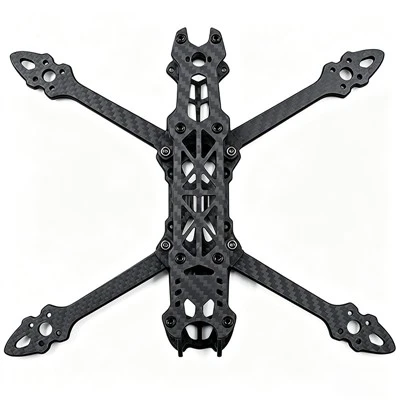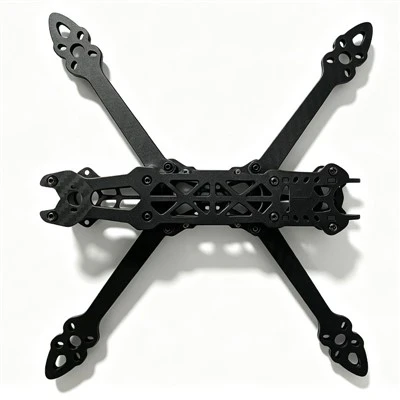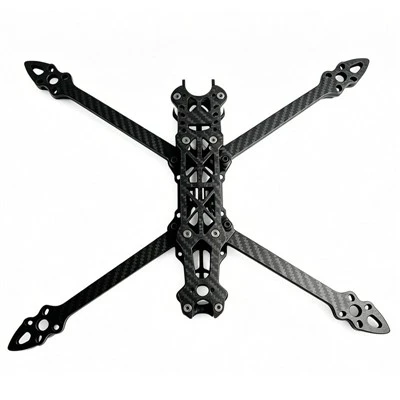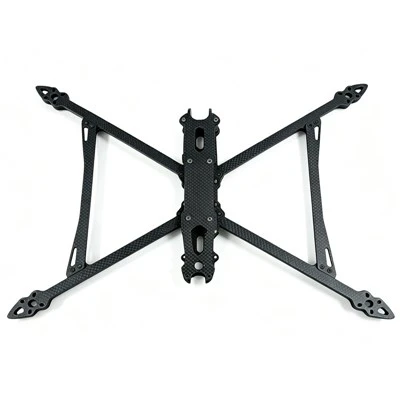
Among all the components of an FPV racing drone, the frame is the only part you will reuse repeatedly for years. Flight controllers will be replaced, motors will burn out, and video transmitters will be upgraded, but a good frame can accompany you through countless rebuilds. Conversely, a poorly designed frame might cause you to snap an arm during your first minor crash, and then you'll have to wait a week to get the spare parts.
The frame determines how large the propellers can be, how the flight controller is mounted, where the antennas are routed, how to repair it after a crash, and the base weight of the entire aircraft before any electronic equipment is installed. It affects vibration, durability, maintainability, and the final flight feel-far more than most pilots realize.
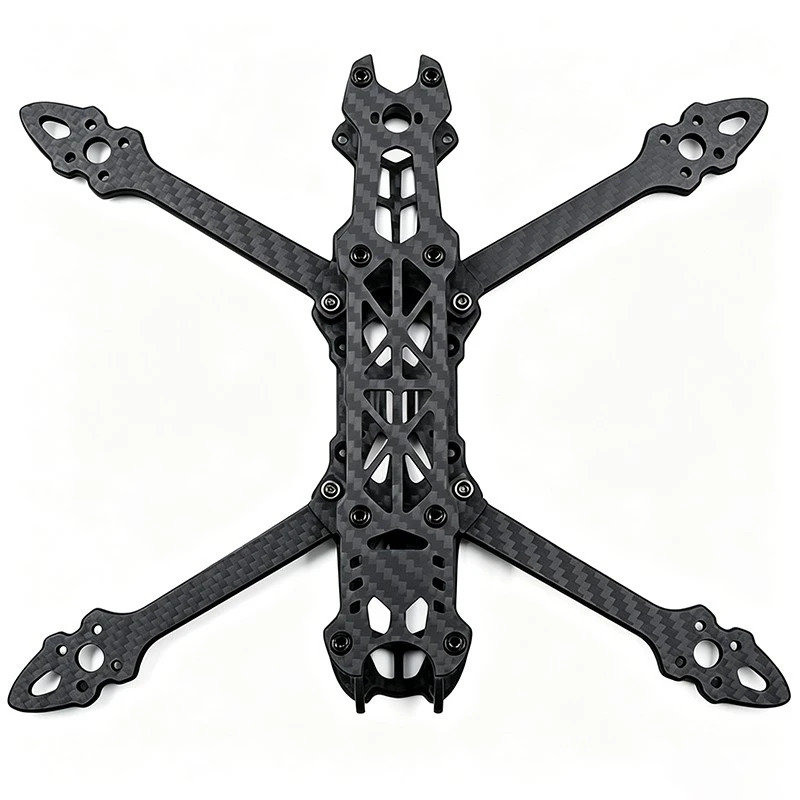
I. Choosing a drone frame is choosing the size-size determines everything.
1.1 Definition of dimensions
Frame sizes are usually named by the maximum propeller diameter they can accommodate, rather than by the wheelbase (diagonal motor-to-motor distance). When people say "5-inch frame", it means the frame is designed for 5-inch propellers. Wheelbase and propeller size are related but not exactly equivalent.
Common sizes and their positioning:
| Size | Paddle diameter | Typical uses | Total weight of the machine | Flight control installation |
| 3-3.5 inches | 3-3.5" | Indoor, ducted fan, narrow space | 150-250g | 20×20mm |
| 5 inches | 5-5.1" | Freestyle, Racing, Freestyle FPV | 500-750g | 30.5×30.5mm |
| 6 inches | 6" | Voyage, cruise | 600-900g | 30.5×30.5mm |
| 7 inches | 7" | Long voyage, load capacity | 800-1400g | 30.5×30.5mm |
The 5-inch class dominates the amateur and consumer markets. The 7-inch and above are more commonly used in scenarios requiring payload capacity and longer flight time.
1.2 Why 5 inches is the default choice
For pilots building their first FPV drone, starting with a 5-inch carbon fiber frame remains the choice least likely to result in mistakes. It has the most abundant ecosystem of accessories, reasonable assembly space, and both budget and high-end frame kits are very easy to find. A common mistake beginners make is choosing a frame based on appearance or price, only to discover during assembly that the 30.5mm flight controller stack, 20mm camera, or video transmitter simply cannot fit.
3-inch is suitable for flying in small spaces and has high maneuverability; 3.5-inch achieves a good balance between portability and power; 4-inch is suitable for pilots with a certain level of experience flying in small spaces. 5-inch is suitable for outdoor flying and offers balanced performance. If your yard is only a few hundred square meters, 5-inch might not be very suitable-3.5-inch would be a wiser training platform.
II. Material: The "grade" of carbon fiber is far more important than the number "3K"
2.1 Why carbon fiber is the absolute mainstream
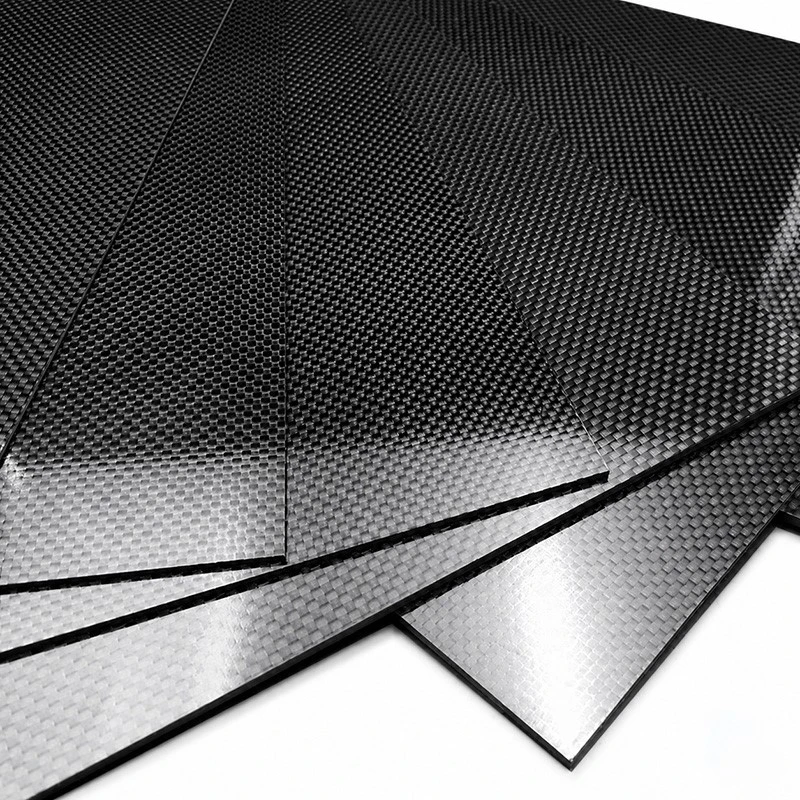
The dominance of carbon fiber in FPV frames stems from its almost irreplaceable specific stiffness. A typical 5-inch carbon fiber arm weighs about 8 grams and can withstand a load of over 15 kilograms before failing. In contrast, a PLA printed part of the same size weighs 10-12 grams, but will break at 3-4 kilograms. Even carbon fiber-filled PETG or nylon can hardly reach half the strength of woven carbon fiber sheets. The tensile strength of aerospace-grade carbon fiber reinforced polymer (CFRP) is 16 times that of PETG Carbon, and its Young's modulus is 10 times higher.
Carbon fiber also has two inherent disadvantages: electrical conductivity and radio frequency shielding. Carbon fiber plates will short-circuit exposed pads and wires, and will also block GPS and some antenna signals. Antennas must be mounted on the outside of the frame, and proper insulation is required between the electronic equipment and the carbon plate.
2.2 Carbon fiber grade - T700, T800 or T1100
Drone frame manufacturers like to boast about "3K carbon fiber", but this term itself has no engineering significance-3K only indicates 3,000 fibers per bundle, which is an appearance weaving specification and does not represent mechanical properties. What truly determines the quality of carbon fiber plates are the fiber grade and the layup process:
- T700: Standard modulus, 240 GPa tensile modulus. Used for budget-level frames ($20-40). Sufficient for 3-inch models, barely enough for 5-inch models - the frame arms are prone to delamination after moderate crashes.
- T800: Intermediate modulus, 294 GPa. Used for mid-range frames ($40-70). A good choice for 5-inch freestyle, able to withstand repeated medium-intensity crashes without delaminating.
- T1100: High modulus, 324 GPa. Used for high-end frames ($70-120). Harder but also more brittle than T800-better suited for racing, as racing prioritizes stiffness over impact resistance.
The layup method is more important than the fiber grade. Alternating fiber directions (0°/90°/±45°) in unidirectional layup between layers can evenly disperse stress. Cheap frames use a full 0°/90° layup, which is very strong along the weave direction but very weak in the 45° direction-and the collision impact on the arm happens exactly in the 45° direction. When purchasing, pay attention to frames labeled as "multi-axial layup".
A practical identification method: tap the arm of the turntable with a screwdriver. High-end turntables will emit a crisp, sustained high pitch like a tuning fork. Budget turntables emit a dull, short sound. A turntable that does not ring indicates invisible delamination inside.
2.3 Location of other materials
Aluminum is mainly used in FPV frames for connectors such as aluminum standoffs and camera mounts. M3-spec 6061-T6 aluminum alloy standoffs balance lightweight, strength, and corrosion resistance; after anodizing, the surface has a micron-level hard layer, making it difficult to damage the threads during repeated assembly and disassembly, and it is less prone to electrochemical corrosion with carbon fiber plates than stainless steel. On micro ducted drones, CNC-machined 7075-T6 aluminum frames (about 9-11 grams) are more resistant to the specific failure mode of "motor mount delamination" than carbon fiber frames-aluminum will bend but will not peel off layer by layer like carbon plates.
III. Arm Geometric Layout: The Foundation of Flight Feel
The arm layout is not just an aesthetic issue. The arm angle, motor position, and center plate layout directly determine the flight feel.
3.1 True X
All arms are of equal length, extending outward from the center at a 90° angle. The distance from the four motors to the center is completely equal, and the control forces on the pitch and roll axes are perfectly symmetrical. This is the standard layout for freestyle and racing, and most 5-inch frames adopt this design. The handling is neutral and balanced, making it suitable for most pilots.
3.2 Stretched X
The front-to-back wheelbase is greater than the left-to-right wheelbase. The front-flying aerodynamic efficiency is higher, the pitch control is stronger, and the airflow interference between the front and rear propellers is smaller. The trade-off is that the roll control is slightly lower, and the PID tuning is a bit more complex. This is the mainstream choice for current 5-inch racing drone frames-the ImpulseRC Apex and TBS Source One both adopt the stretched X geometry.
3.3 Deadcat / Squashed X
Spread the front arms outward and adjust the angle of the rear arms to completely move the propellers out of the camera's field of view. For pilots shooting cinematic footage, this setup is almost a must-the HD camera will not capture the propellers.
The trade-off is an asymmetrical motor layout, which introduces slight yaw-roll coupling. Modern PID tuning can basically compensate for this issue, having little impact on smooth cinematic flight. However, during high-speed flight, the asymmetrical frame may produce strange yaw coupling that is not obvious at low speeds. Another hidden danger is crash durability-the forward-protruding design makes the camera more prone to damage in frontal impacts.
3.4 H-frame
The arms are arranged in parallel, and the center plate area is long and spacious, making it very convenient for mounting equipment, suitable for long-range and heavy-lift models. It is structurally more stable but heavier, with a larger moment of inertia on the pitch axis, and its agility is inferior to the X-layout. In recent years, the amateur market has basically shifted to X-frame designs.
3.5 Layout Comparison Quick Reference
| Layout | Arm arrangement | Most suitable | Short board |
| True X | Equal length, 90° | Freestyle, racing | Limited camera protection |
| Stretch X | Longer forearms | Freestyle, anti-paddle wash | Yaw slightly slow |
| Deadcat | Forearm supination | Movie shooting | Yaw asymmetry, high-speed coupling |
| H-frame | Parallel arm | Long voyage, load-carrying | Heavy, low agility |
IV. Arm Thickness and Design Details
4.1 Thickness Selection - Classified by Model
The arm is the first part to break when the drone crashes. Thickness directly determines the impact resistance, but also affects the weight.
3 inches and below:
3mm is enough. The 1404 motor will not bend a 4mm carbon plate, so there is no need to increase the weight.
01
3.5-inch:
3-3.5mm. The 1505/1604 motor class benefits from slightly higher stiffness, but does not need to bear the weight penalty of 4mm.
02
3-3.5mm. Racing frames sacrifice durability for weight. Equipping racing frames under 400g with 3mm arms is the standard practice.
03
4-5mm. 4mm single plate is suitable for lightweight 2207 configurations with a weight below 650g. 5mm is the minimum requirement for 2306 motors and a total aircraft weight above 700g to withstand concrete crashes. Each arm differs by 3-4 grams, which is not a small amount for the entire aircraft-but the cost of a broken arm is even greater.
04
minimum 6mm. The leverage effect of 7-inch propellers will generate a bending moment on the long arms that 4mm carbon fiber plates cannot withstand. 4mm arms on a 7-inch quad may fold at full throttle.
05
4.2 Replaceable arm vs integrated baseplate
Replaceable arms:
Each arm is individually secured to the main frame with bolts. If one arm breaks, you only need to replace that specific arm. For beginners and aggressive freestyle pilots, replaceable arms can pay for themselves within the first month.
Unibody frame:
The arms and the frame are cut from a single piece of carbon fiber. It is usually lighter and stronger, but breaking one arm means replacing the entire frame-the workload of rebuilding the whole aircraft.
4.3 Stress point design
Avoid including sharp corners in the design of the organic arm. Curved and rounded cuts are much stronger than right angles-sharp corners are areas of stress concentration, and are the most likely to break from here when the drone crashes. Beveled edges are not only more impact-resistant, but also prevent cutting the wires and battery straps.
V. Pre-installation Compatibility Checklist
| Check item | Content to be confirmed |
| Flight control installation | 30.5×30.5mm or 20×20mm? Which one does the frame support? |
| Motor installation | 16×16mm or 19×19mm? Do the standard mounting holes match? |
| FPV camera | Micro or nano-sized? Adjustable tilt range? |
| HD camera | Is a 3D printed bracket needed? Is it included in the kit? |
| Image transmission | Is the antenna installation space sufficient? Does it support the target video transmission system? |
| Spare parts supply | Can the arm, base plate, and top plate be purchased separately? |
For a first-time build, choosing a 5-inch carbon fiber frame that simultaneously supports both 20×20 and 30.5×30.5 mounting holes and provides replaceable arms is the most hassle-free answer.
VI. Vibration and Resonance - The Underlying Logic of Frame Design
VII. Battery Installation and Center of Gravity
The battery of a flying plane is usually placed at the top for two reasons: the center of gravity is closer to the propeller plane, reducing the moment of inertia and providing a better feel during turns; and during repeated landings, the battery will not directly hit the ground, reducing the risk of damage. Racing frames often place the battery at the bottom due to insufficient space at the top.
The weight distribution of the frame also affects the flight feel. Frames weighing over 130 grams (excluding electronics) feel more "solid" in strong winds, but require more throttle to change direction, making them feel sluggish on technical tracks. Frames under 80 grams are very agile in the air but easily tossed around by gusts. For 5-inch racing drones, a frame between 90 and 120 grams is usually the ideal balance point.
VIII. 3D Printed Full Machine Frame - When It Is Feasible, When to Avoid It
The appeal of 3D printing a whole frame is self-evident: download the STL file, print for a few hours, spend a few dollars on filament and you get a frame, and if it breaks, just print another one. But the laws of physics do not cooperate.
01
The core issue is not strength, but stiffness and damping. The high stiffness and internal damping characteristics of carbon fiber naturally filter out high-frequency vibrations. PLA and PETG frames act like tuning forks, generating resonance in specific RPM ranges, which is enough to overwhelm Betaflight's filtering capabilities.
02
2.5 inches and below: For micro quads using 1103-1204 motors and 2.5-3 inch props, 3D printed frames are feasible. The vibration amplitude is low enough to be handled by modern gyroscope filtering. The Dave_C Flex-25 and NBD Hummingbird 3D printed frames have accumulated a large number of successful flight cases.
03
3.5 inches and above: Most printer racks either shake themselves apart or generate unflightable gyro noise after the first few batteries. Carbon fiber reinforced nylon (such as PA6-CF) can narrow the gap, but cannot eliminate it.
04
Practical advice: buy carbon fiber for the frame, and use 3D printing for accessories. Camera mounts, antenna holders, arm protectors-these flexible parts are exactly where 3D printing excels, as the elasticity of TPU offers unparalleled advantages over carbon fiber in terms of cushioning and shape complexity.
05
IX. Decision-making Process and Common Pitfalls
Fast decision-making process
Determine the size.
Indoor/small spaces → under 3 inches; outdoor general/first-time build → 5 inches; long-range/heavy-duty → 6-7 inches. Do not choose the size based on appearance.
01
Determine the layout.
Freestyle/Racing → True X or Stretch X; Cinema shooting requires the props to be out of frame → Deadcat; Long-range → H-frame or Deadcat variant.
02
Determine the carbon fiber grade and arm thickness.
Limited budget but pursuing crash resistance → T800 mid-range frame + 5mm arms; Racing → T1100 or T800 + 3-3.5mm arms; Long-range → T700 or T800 + 6mm arms.
03
Confirm compatibility and spare parts.
The flight controller mounting holes, camera size, and video transmitter installation position must all match. Confirm that the arms and bottom plate can be purchased separately.
04
Common misconceptions
The thicker, the more bomb-proof
A 6mm arm has 44% more windward area than a 5mm arm, consuming 8-12A more current at 120km/h, which is nearly 10% extra power consumption. The thin arms of racing frames are a performance trade-off, not cutting corners.
The clone is the same as the original
The clone uses T300 equivalent carbon cloth and polyester resin, but the pressing and curing pressure is insufficient, resulting in microscopic voids between layers. The $25 arm breaks on the third hard impact, while the $80 arm can withstand over 50.
3D printing can replace carbon fiber
It works on micro drones under 2.5 inches, but not on larger sizes. The principle lies in the matching of resonant frequencies, not simply "whether it is stiff enough".
Buy the frame first, then choose the accessories
It's backwards. First confirm the flight controller, video transmitter, and camera you plan to use, then choose a frame that supports these components. A frame that doesn't fit is useless no matter how good it looks.
FAQ
Q: What is the difference between wheelbase and frame size of FPV drone frame?
A: Frame size is defined by the maximum propeller diameter it can fit, not wheelbase. Wheelbase refers to the diagonal distance between two opposite motor mounting holes. Two frames with identical prop size may have different wheelbase designs.
Q: Is higher carbon fiber grade (T1100) always better than T800?
A: Not always. T1100 has higher stiffness but is more brittle. It works best for racing frames prioritizing lightweight and rigidity. T800 balances stiffness and impact resistance, which is the preferred option for freestyle pilots who encounter frequent crashes.
Q: What is multi-axial layup, why does it matter for carbon fiber frame?
A: Multi-axial layup stacks carbon fiber sheets in alternating directions (0°/90°/±45°). It disperses crash stress evenly. Low-cost frames only use simple 0°/90° layup and easily crack under 45-degree impact, which is the most common crash force direction.
Q: Replaceable arm vs unibody frame, which one should I pick?
A: Choose replaceable arms for beginners and freestyle users. If one arm breaks, you only replace the damaged arm and save cost. Unibody frames are lighter, but damage to any arm means replacing the whole frame.
Q: How to reduce frame resonance and vibration?
A: Select a frame with proper arm thickness and multi-axial carbon layup. Ensure tight clamping between carbon plates to create friction damping. Keep the frame resonance frequency out of 120–180Hz range to avoid PID oscillation.
Q: Can I use 3D printed frame for 5-inch FPV drone?
A: Not recommended. 3D printed materials such as PLA/PETG have poor stiffness and damping. They easily generate strong gyro resonance. 3D printed structures are only suitable for 2.5-inch and smaller micro quads.