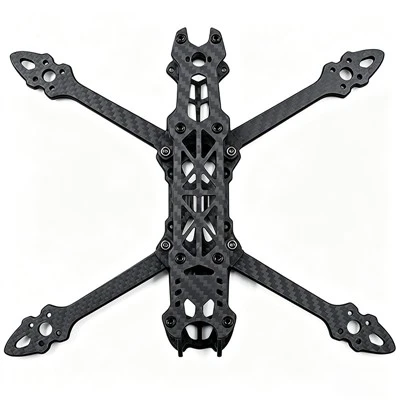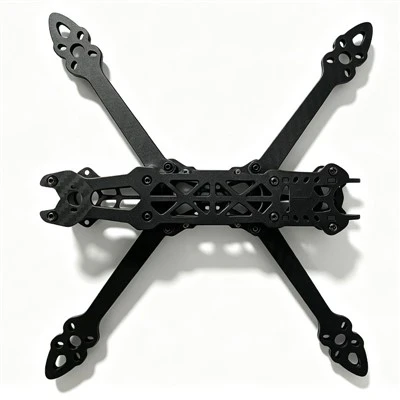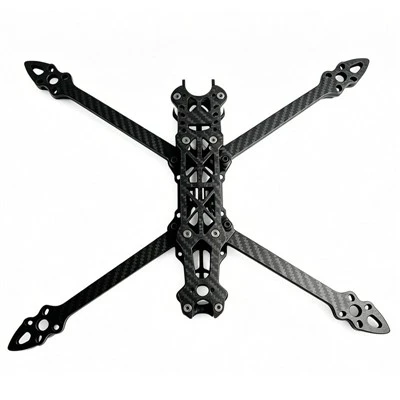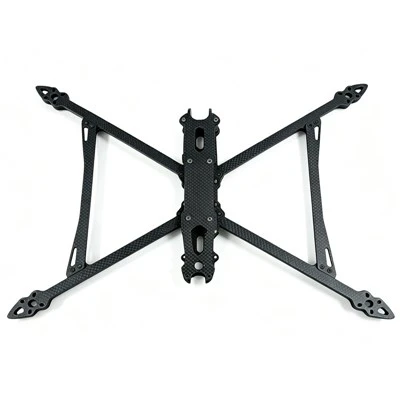
1. Selecting the motor, work backwards from the frame and the propeller blades, do not start from the motor.
The order in which most beginners choose motors is wrong. The correct process is the reverse: first determine the frame size and propeller size, then choose the KV based on the battery voltage, and finally determine the stator size based on the thrust requirements. Attempting to install a 5-inch motor on a 3-inch frame is one of the most common build mistakes made by beginners.
A simplified selection chain:
Chassis wheelbase
1
>>
Blade diameter
2
>>
Number of batteries in series
3
>>
KV value
4
>>
Stator size
5
>>
Verify ESC margin
6
Once the propeller diameter is determined, the "volume upper limit" of the motor stator and the "reasonable range" of the KV are basically locked in. The subsequent work is to fine-tune within this range according to the flying style.
II. Stator Dimensions: The Physical Meaning Behind the Numbers
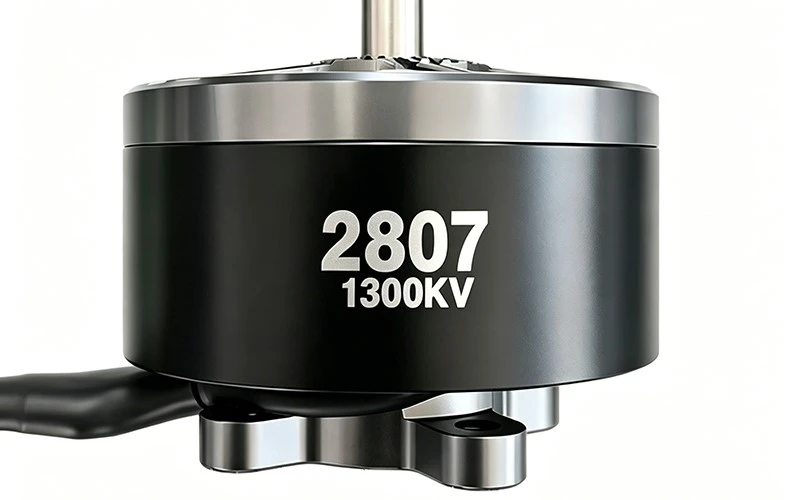
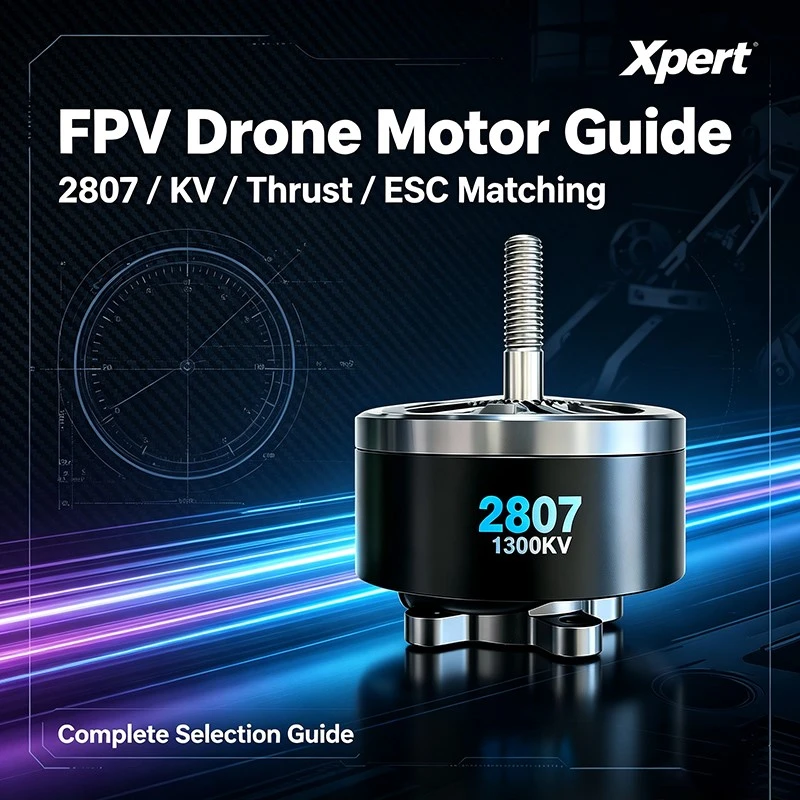
Motor models such as 2807 and 3115, the first two digits are the stator diameter (mm), and the last two digits are the stator height (mm). 2807 means a stator with a 28mm diameter and 7mm height.
The most easily misunderstood point here is that what determines the torque potential of a motor is not diameter or height alone, but the stator volume.
The stator volume can be estimated using the cylinder formula:
Stator volume = π × (diameter/2)² × height
Taking the two most common 5-inch motors as an example:
| Model | Stator volume | Typical weight | Maximum thrust (6S, 5″ prop) | Positioning |
| 2207 | ≈2,660 mm³ | 32-35g | ≈1,400g | Freestyle dessert area |
| 2306 | ≈2,493 mm³ | 33-36g | ≈1,500g | FPV Racing & Heavy Freestyle Drones |
| 2204 | ≈1,520 mm³ | 25-28g | ≈850g | Sub-250g ultra-light |
The stator volume of the 2207 is about 6.6% larger than that of the 2306, meaning it can accommodate more copper wire and silicon steel laminations, thereby handling higher current and outputting greater peak power.
But this does not mean the 2207 is "better". The difference in shape between the two determines a different flying feel:
2207 (narrow and tall): The high turn count allows for longer copper wire winding, increasing the conductive cross-sectional area and providing better heat dissipation. The power output is biased towards non-linearity, with a significant increase in thrust in the latter half of the throttle, making it suitable for scenarios requiring instantaneous explosive power, such as racing straight-line acceleration.
2306 (Wide and Short): The wider stator diameter increases the effective lever arm of the torque, making the torque output curve more linear and predictable. It is more efficient in the low-to-mid throttle range, making it suitable for continuous maneuvers in freestyle flying and film shooting.

III. KV value: It is a speed constant, not a power indicator.
The definition of KV is the speed corresponding to each volt under no-load. A 2000KV motor under 6S (fully charged 25.2V) has a target no-load speed of approximately 50,400 RPM.
Core concept: High KV does not equal high power. High KV means a higher RPM at the same voltage, but lower torque and higher current. Low KV is the opposite-lower RPM, higher torque, lower current, and higher efficiency. This is just like the gears on a bicycle: low KV is a low gear, powerful for climbing hills but with a limited top speed; high KV is a high gear, very fast on flat roads but struggling on uphills.
The core logic of KV selection has only one: battery voltage determines the KV range.
6S requires low KV, and 4S requires high KV. For the same 5-inch quadcopter, the 6S system uses 1700-1950KV, while the 4S system uses 2450-2750KV. The target no-load RPM of both is close-it is just that the 6S achieves it with high voltage and low current, resulting in higher efficiency and lower heat generation.
The following is the KV reference range compiled from multiple sources, covering mainstream models:
| Model/Scenario | Blade | Battery | Recommended KV range |
| Tiny Whoop 65mm | 31mm | 1S | 23,000-30,000 |
| Tiny Whoop 75mm | 40mm | 2S | 12,000-14,000 |
| 2.5″ Toothpick | 2.5″ | 3S | ~6,000 |
| 3″ Toothpick | 3″ | 4S | 3,500-4,000 |
| 5″ Freestyle | 5″ | 4S | 2,400-2,750 |
| 5″ Freestyle | 5.1″ | 6S | 1,700-2,000 |
| 5″ Racing | 5″ | 6S | 1,950-2,150 |
| 7″ Long Range | 7″ | 6S | 1,200-1,500 |
| 3″ Cinewhoop | 3″ | 4S | 3,500-4,000 |
The current "sweet spot" for 5-inch 6S freestyle is 1850-1950KV paired with 5.1-inch low-pitch propellers. If you are pursuing racing, you can go up to 2000-2150KV; if you prefer cinematic filming and stability, 1700-1850KV is more suitable.
IV. Propeller Matching: A Complete Powertrain Mindset
Choosing the right motor is only the first step; the motor, propellers, and battery must be matched as a system.
Pitch
Pitch is the theoretical distance a propeller advances in one full rotation (inches). A high pitch provides more thrust at high speeds, but current consumption increases significantly. For freestyle, 4.3-4.6 is the sweet spot; for racing, 4.8-5.0 is used; for long-range, a low pitch of 3.5-4.0 is used to improve cruising efficiency.
Number of blades
Tri-blades are the standard configuration for FPV, offering the best balance of thrust, efficiency, and control. Dual-blades have higher efficiency and faster top speeds, but lack grip during turns, and are commonly used in long-range scenarios. Quad-blades and above provide the maximum thrust but have very low efficiency, and are mainly used in scenarios like Cinewhoops that require high static thrust.
An easily overlooked matching principle: the larger the propeller diameter, the larger the required stator volume, and the lower the KV should be. For a 7-inch long-range flight, use a 2506-2806.5 stator with 1200-1500KV, rather than forcing it with a 5-inch 2207 motor.
V. Thrust-to-weight ratio: Final verification indicator
The thrust-to-weight ratio (TWR) is the ratio of the maximum thrust of the entire aircraft to its takeoff weight, and is the ultimate indicator for verifying whether the propulsion system is reasonable.TWR targets for different flight styles:
| Flight style | Target TWR | Instructions |
| Long-haul/Cruise | 2:1-3:1 | Efficient and gentle |
| Freestyle | 4:1-5:1 | Sweet spot, balancing power and range |
| Racing/Aggressive Freestyle | 6:1-8:1 | High response, strong acceleration |
| Professional Racing | 8:1-12:1 | Ultimate power, extremely short battery life. |
VI. Common Misconceptions and Pitfalls to Avoid List
Pitfall 1: High KV = Strong power.This is the most common misconception. Heavy-lift machines (large propellers, high weight) use high KV motors, forcing the motors to operate outside their torque range, where a large amount of energy is converted into heat instead of thrust. The result is a three-minute flight time, burning hot motors, and flight controller jitter.
Pitfall 2: Only looking at KV and stator size, ignoring total weight.The four large stator motors look very "powerful", but the increased rotational inertia makes it harder for the flight controller to adjust the RPM quickly, resulting in more noticeable prop wash and a "dull" feel.
Pitfall 3: Ignoring the ESC margin. The continuous current rating of the ESC should be at least 1.2-1.3 times the measured peak current of the motor. If the peak current of the motor is 30A, an ESC of at least 40A should be selected. Insufficient margin will lead to ESC frequency reduction protection or even burning out.
Pitfall 4: Ignoring the magnetic steel grade. The magnetic steel of the motor is graded from N35 to N54, and the larger the number, the stronger the magnetic field. High-end motors use N52H or N54H, where the "H" suffix represents high-temperature resistance. Cheap motors commonly use low-grade magnetic steel, which is easily demagnetized under large currents, manifesting as "the faster it flies, the less power it has."
Pitfall 5: Not conducting a blade separation test after installation. When checking motor order, direction, and moving sliders in Betaflight, the propellers must be removed for operation. This is a basic safety rule, but pilots are still injured because of it every year.
VII. Summary of the Quick Selection Process
5-inch drones are paired with 5 to 5.1-inch propellers, and 3-inch drones are paired with 3-inch propellers, do not mix and match.
The mainstream for 5-inch quads is 6S, 4S is still usable but the efficiency is relatively low. Choose low KV for 6S, and high KV for 4S.
For 5-inch 6S, choose 1850-1950KV for freestyle, 2000-2150KV for racing, and 1700-1850KV for cinematic. For 4S, choose 2400-2750KV.
For freestyle, 2207 or 2306 are the top choices; for racing, 2306.5 or 2207.5 can be considered; for film and television shooting and long-range flight, 2408 or 2506 can be considered.
freestyle flight target 4:1 or above, racing 6:1 or above.
ESC continuous current ≥ motor peak current × 1.25.
N52H and above, dual bearings are a basic requirement.
VIII. One-sentence summary
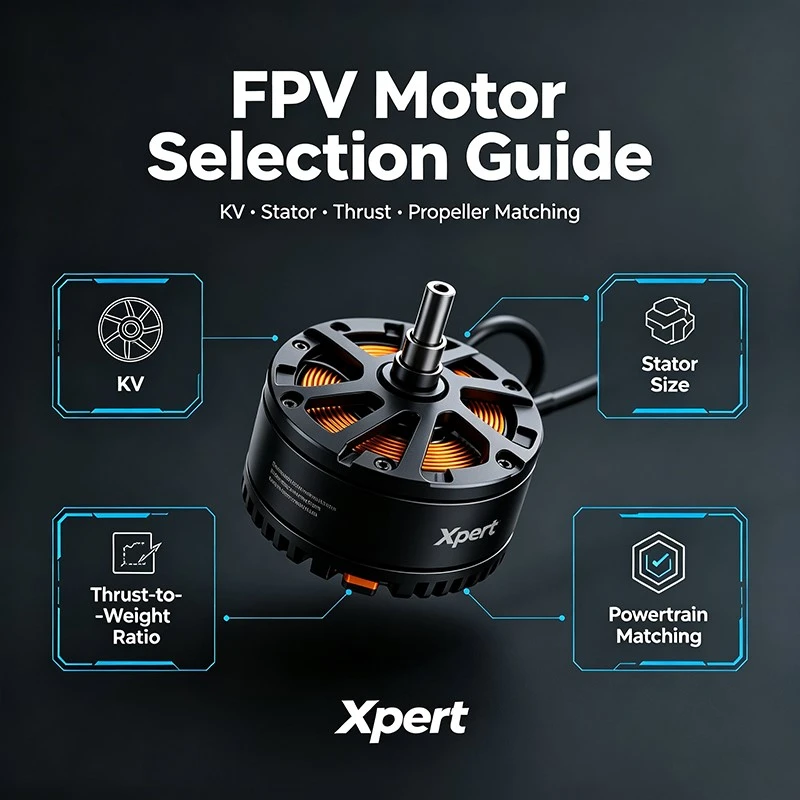
There is no "best motor", only a motor that matches your frame, battery, propellers, and flying style. KV controls speed, stator volume controls torque, propellers control load, and batteries control the voltage platform-these four variables must be selected as a system; optimizing any one of them individually is meaningless.
FAQ
Q: Does higher KV mean more power?
A: No. KV is the no-load speed constant, representing the speed per volt of voltage. A high KV motor has a higher speed at the same voltage, but lower torque and higher current. The strength of the power also depends on the stator volume, magnets, winding, and propeller matching.
Q: What KV for 5-inch 6S freestyle?
A: The mainstream sweet spot is 1850–1950KV, paired with a 5.1-inch low-pitch tri-blade propeller. For racing-oriented builds, 2000–2150KV is an option; for cinematic stability and long flight time, 1700–1850KV is an option. The final choice depends on the thrust-to-weight ratio and motor temperature.
Q: How to compare KV for 4S and 6S?
A: Target no-load speed: KV × voltage. 6S fully charged is about 25.2V, 4S fully charged is about 16.8V. 6S 1800KV ≈ 4S 2700KV, the target speeds of both are close. 6S uses lower current to achieve the same speed, with higher efficiency and lower heat generation.
Q: How to calculate stator volume?
A: Approximate formula: π × (diameter ÷ 2)² × height. 2207 is about 2660mm³, 2306 is about 2493mm³. The larger the volume, the more copper wire and silicon steel it can accommodate, and the greater the potential to handle current and peak power, but the weight and rotational inertia will also increase.
Q: How to choose prop pitch?
A: Use 4.3–4.6 for freestyle, 4.8–5.0 for racing, and 3.5–4.0 for long-range. High pitch provides high speed and high thrust, but current increases significantly; low pitch offers high cruising efficiency but lower top speed. The pitch must be matched with the KV and voltage.
Q: Tri-blade vs bi-blade vs quad-blade?
A: Tri-blades are the FPV standard, offering the most balanced thrust, efficiency, and control. Dual-blades have high efficiency and high top speed, suitable for long-range flights, but have weak grip during turns. Four-blades and above provide the maximum thrust but low efficiency, mostly used in scenarios like Cinewhoops that require high static thrust.