Why the battery life of the 15-inch platform cannot be solved by "swapping for a larger battery"

For the 15-inch FPV platform, flight time optimization cannot be achieved simply by increasing battery capacity or reducing weight. Unlike the 5-inch or 7-inch platforms, the 15-inch platform typically carries a larger payload, uses a higher voltage system, and is equipped with larger propellers, involving more variables and more complex coupling relationships.
The core issue is that flight endurance is the output result of the entire system, not the attribute of a single component. The motor, ESC, flight controller, battery, propellers, frame, and wiring method affect each other. With the same battery capacity, the flight time of two 15-inch platforms may differ by more than double, and the difference often comes from component selection matching and tuning quality.
The following systematically reviews the battery life optimization methods for the 15-inch platform from six key dimensions.
I. Motor selection: Low KV + large propeller is the basic logic
The motor is the core of the power system and directly determines the energy conversion efficiency.
Basic principle: low KV paired with large propellers, high KV paired with small propellers. Low KV motors have high torque and low RPM, and when paired with large diameter propellers, they can generate sufficient thrust at lower RPMs, with higher air utilization efficiency, making them especially suitable for long-endurance missions that require continuous thrust output. High KV motors have high RPM and low torque, making them suitable for small propeller high-speed scenarios (such as racing and light-load models), but using them on large propellers or heavy-load platforms will increase current consumption and heat generation.

Key points for motor selection of the 15-inch platform:
KV range:
Selected according to the voltage system. A 12S system is usually paired with motors in the 280–400 KV range, an 8S system can choose 350–420 KV, and a 6S system is suitable for the 400–600 KV range.
Stator sizes:
4315, 4715,5215, and 5315 are common levels for 15-inch platforms. The larger the stator, the more abundant the torque output, but the weight also increases. For light-load long-endurance, the 4214–4315 levels are optional, while heavy-load platforms require 5215 or 5315.
Efficiency takes precedence over peak power:
when choosing a motor, attention should be paid to its efficiency performance in the commonly used throttle range (around 50% throttle), rather than peak thrust. When the motor operates in its highest efficiency region, energy utilization is maximized, which can effectively extend the range by 10–20%.
Flat-wire stator and arc magnets:
This type of design can reduce cogging torque and improve efficiency under partial throttle, which is particularly beneficial for long-endurance cruising.
Measured data reference: Taking a certain 5315 280KV motor paired with a C15×10×3 propeller as an example, at 12S voltage, the thrust efficiency is about 11 g/W at 30% throttle, about 6.9 g/W at 50% throttle, and rapidly drops to below 5 g/W after exceeding 70% throttle. This means that controlling the cruise throttle within the 30%–50% range will yield the highest energy utilization efficiency.
II. ESC and Power Distribution System: Current Margin is More Important Than Nominal Parameters
The ESC is responsible for efficiently delivering battery power to the motor. An improperly matched ESC will lead to overheating, unstable output, sluggish throttle response, and unnecessary power loss.
ESC selection principles:
Current margin:
The continuous current rating of the ESC should be greater than the maximum current of the motor at 100% throttle, and it is recommended to keep a safety margin of 20%–30%. For example, when the full-load current of the motor is 40A, choosing a 50A or 60A ESC is more reasonable.
Voltage support:
The maximum supported voltage of the ESC must exceed the fully charged voltage of the battery. High-voltage systems can reduce the operating current at the same power output, reducing line loss and voltage drop.
Protocol Support:
For platforms requiring fine attitude correction, ESCs supporting the DShot protocol can provide a higher refresh rate and faster response speed.
Heat dissipation design:
The 15-inch platform has a large current, and the ESC should be installed in a well-ventilated position to avoid heat accumulation in a closed space.
PDB (Power Distribution Board) selection: The PDB should be selected based on voltage, continuous/peak current, wire diameter, and interface requirements, rather than size labels like "15 inch". 15-inch platforms typically use 6S–12S batteries, and the PDB input voltage range should cover 4S–15S (approx. 14–62V), while the continuous current rating must cover the maximum total current requirement of the platform. When wiring, the paths from the battery to the PDB and from the PDB to the ESC should be kept as short as possible to reduce line loss.
III. Flight Controller Selection and Parameter Tuning: Reducing Unnecessary Energy Consumption

The impact of flight control on energy consumption is often underestimated. The flight controller continuously adjusts the motor output through a PID controller to maintain attitude stability. Improper tuning can lead to frequent micro-adjustments, oscillations, or overcorrections of the motors, and these "invisible consumptions" will significantly shorten the flight time.
Energy consumption optimization directions in parameter tuning:
Reduce attitude sensitivity:
Excessively high PID gains will cause the motors to constantly make micro-corrections, increasing current consumption. Appropriately reducing the P and D gains, allowing the aircraft to remain stable rather than "tense" during cruise, can reduce energy waste.
Filter Settings:
The motor noise frequency of large prop platforms (15 inches) is lower, and the default 5-inch filter parameters are often not applicable. Appropriately increasing the Q value of the dynamic notch filter (e.g., 3.5–4.0) can filter out high-frequency vibration noise while retaining low-frequency control authority. The RPM filtering function performs precise filtering based on the motor RPM data fed back by the ESC, which directly helps in reducing motor heating and energy consumption.
PID loop rate:
For large propeller platforms like the 15-inch, an excessively high PID loop rate does not necessarily bring benefits. Large propellers have a high moment of inertia and a relatively slow response speed, so appropriately reducing the loop rate (such as 4kHz or 2kHz) can instead reduce unnecessary motor command jitter.
Cruise mode settings:
Independent cruise PID profiles can be set in Betaflight to reduce the I-term accumulation rate, avoiding overcorrection caused by the accumulation of minor deviations during long-duration cruising.
Flight controller hardware selection: For the 15-inch platform, it is recommended to use an F7 or H7 level processor to ensure there are enough UART interfaces for peripherals such as GPS, video transmission, and telemetry, while guaranteeing the real-time performance of filtering and PID calculations.
IV. Battery Selection: Energy Density is More Critical Than Specific Capacity Figures
The battery is one of the core variables for optimizing range, but "larger capacity" does not equal "longer range".
Lithium battery vs. Lithium-ion battery: This is the most noteworthy option in the battery life optimization of the 15-inch platform. Lithium polymer batteries (LiPo) have an energy density of about 150 Wh/kg, while lithium-ion batteries (Li-ion, 18650/21700 cells) can reach about 240 Wh/kg, which is about 60% higher. This means that at the same weight, Li-ion batteries can store more energy.
But Li-ion also has its drawbacks: its continuous discharge capability is lower than that of LiPo, making it unsuitable for a flying style that requires high-current bursts. For long-endurance platforms primarily focused on smooth cruising, Li-ion is the better choice; for scenarios requiring frequent acceleration or heavy-load takeoffs and landings, the high discharge performance of LiPo is more reliable.
Key points for battery selection:
Capacity matching platform requirements:
Blindly increasing capacity will increase weight, the motor will need more thrust, and the rising current may offset the capacity benefits. Capacity should be selected based on the platform's actual power requirements and target flight time.
Voltage platforms:
15-inch platforms commonly use 6S, 8S, and 12S systems. High-voltage systems have lower current at the same power, resulting in less line loss and heat generation. 8S or 12S systems have obvious advantages in heavy-load and long-endurance scenarios.
Internal resistance and discharge curve:
Select battery cells with low internal resistance to ensure a small voltage drop under cruise current, avoiding the flight controller prematurely triggering low voltage protection due to voltage drop.
Regular maintenance and replacement:
After battery aging, the internal resistance increases and the effective capacity decreases, which will directly shorten the flight time. It is recommended to regularly test the internal resistance and replace aged batteries in a timely manner.
Actual reference: A certain 15-inch platform, with a takeoff weight of 13kg, a 12S 30000mAh battery, and a cruising speed of 100km/h, has a flight time of 32 minutes and a flight distance of 53 kilometers. When the takeoff weight increases to 32kg (22kg payload), a 40000mAh battery is used, and the cruising speed drops to 80km/h, the flight time plummets to 10 minutes, and the flight distance is only 13 kilometers. This shows that the impact of weight on endurance is far greater than the compensation brought by the increase in capacity.
V. Propeller Selection: The two-blade propeller is superior to the three-blade propeller in cruising efficiency.
The blades are the components in the power system that directly interact with the air, and their selection has a significant impact on efficiency.
Number of blades:
At cruising speed, a two-blade propeller is about 8%–12% more efficient than a three-blade propeller. A three-blade propeller provides higher thrust density and better response, but also has greater drag. For long-endurance platforms primarily operating at cruise, a two-blade propeller is the better choice.
Propeller diameter and pitch:
Propellers with a large diameter and low pitch generate greater thrust at low rotational speeds and are more efficient. For a 15-inch platform, a propeller diameter and pitch that match its motor KV and voltage should be selected. A propeller diameter that is too large or a pitch that is too high will cause the motor to overheat due to overload, which in turn reduces efficiency.
Propeller balance:
Unbalanced propellers will generate extra vibration, requiring more corrections from the flight controller, which indirectly increases energy consumption. The dynamic balance of the propellers should be checked before use.
VI. Load Layout and System Planning
The impact of payload and layout on range is often underestimated.
Targeted weight reduction:
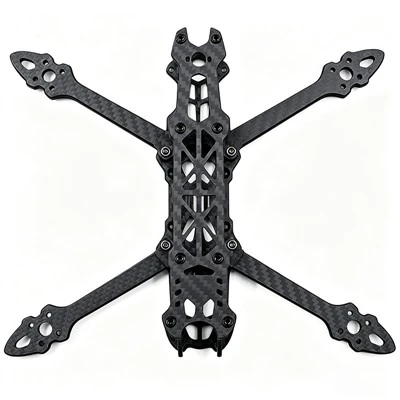
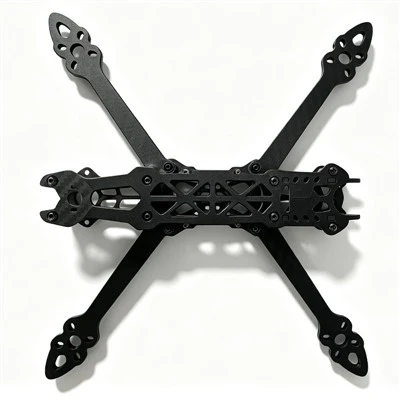
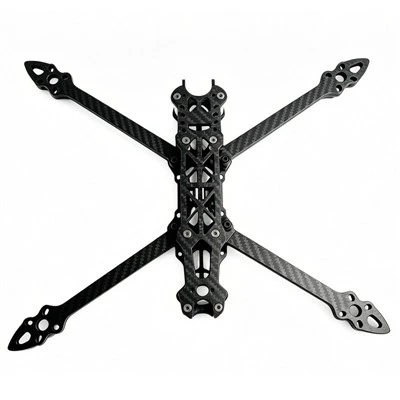
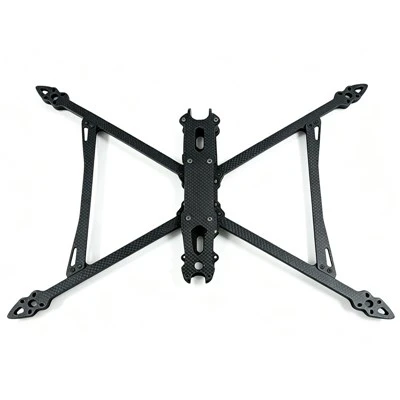
It is not simply about stripping down the equipment, but about removing redundant components, optimizing wiring, and using lightweight materials. The rack, motor, propellers, and battery of the 15-inch platform itself already account for most of the weight, so the space for simple weight reduction is limited, and priority should be given to optimizing those "non-functional" weights.
Center of gravity balance:
A shift in the center of gravity will cause the flight controller to continuously perform attitude corrections. A reasonable layout should place the battery and heavy equipment close to the center of the frame, maintaining a weight balance in the front, back, left, and right. A shift in the center of gravity not only increases energy consumption but also reduces flight stability.
Communication and expansion reservation:
If the platform may need to add image transmission, telemetry, or data link modules in the future, power interfaces, installation space, and wiring channels should be reserved in the early design stage. Late-stage additions often require a complete layout redesign, which may disrupt the existing center of gravity balance.
Battery Life Optimization Checklist:
| Project | Key points |
| Motor | Low KV + large propeller; focus on efficiency in the commonly used throttle range rather than peak thrust; stator size matched with load. |
| ESC | Retain 20–30% current margin; voltage support covers the fully charged battery voltage; pay attention to heat dissipation. |
| PDB | Select by voltage, current, and wiring requirements, rather than by size labels; shorten the discharge path. |
| Flight control | Reduce unnecessary attitude corrections; appropriately adjust the filtering parameters of the large paddle platform; select F7/H7 processors. |
| Battery | Li-ion is suitable for long-endurance cruising; avoid blindly increasing capacity; focus on energy density and internal resistance. |
| Blade | Cruise priority dual-blade propeller; propeller diameter matches motor KV; check dynamic balance. |
| Load | Targeted weight reduction; maintain center of gravity balance; reserve expansion interfaces |
Conclusion
The endurance optimization of a 15-inch FPV platform is a systems engineering project. The matching of motors and propellers determines the basic efficiency, the ESC and PDB ensure the stability of power transmission, flight controller tuning reduces "invisible consumption", battery selection determines the energy reserve, and the load layout affects the actual flight performance. A shortcoming in any single link may offset the optimization effects of other parts.
In actual projects, it is usually not necessary to replace all components. By starting with the least efficient link and gradually optimizing the matching relationship, a considerable improvement in range can be achieved without significantly increasing costs.
FAQ
Q: Is a bigger battery always the best way to get longer flight time?
A: No. A larger battery adds weight to the entire airframe. The motors must produce more thrust to keep the aircraft airborne, which draws more current and can partially or fully offset the extra capacity. The battery also shifts the centre of gravity, and the flight controller must work harder to maintain attitude, consuming additional energy. A better approach is to evaluate whether the platform is already using its energy efficiently before adding capacity.
Q: My 15-inch FPV drone only flies for 8–10 minutes. Where should I start troubleshooting?
A: Start with three checks: (1) Motor-prop efficiency - measure current draw at hover throttle; if it is above 50–55% throttle, the motor is likely overloaded or the KV is too high. (2) Weight audit - weigh the platform without battery and compare against the intended all-up weight; remove redundant wiring, oversized mounts, and unused accessories. (3) Battery health - check internal resistance; aged packs lose effective capacity and suffer voltage sag under load.
Q: What KV range is suitable for a 15-inch FPV platform?
A: KV depends on the voltage system and intended payload. For 12S systems, 280–400 KV is typical; for 8S, 350–420 KV; for 6S, 400–600 KV. A 5315 280KV motor on a 15-inch X4 frame, for example, is rated for 6–12S with a max power of 2502W and peak current of 93.37A. The key principle is low KV plus large props - high torque at low RPM delivers the best efficiency for endurance builds.
Q: Can I use high-KV racing motors on a 15-inch platform?
A: You can, but it is inefficient. High-KV motors have low torque and high RPM, which suits small props and lightweight builds. On a 15-inch platform with large props, a high-KV motor will overheat and draw excessive current because the motor's maximum torque cannot efficiently drive the propeller load. This leads to wasted energy and potential motor demagnetization or burnout.
Q: How do I check whether my motor is running in its efficient range?
A: Look at the thrust efficiency curve (g/W) provided by the motor manufacturer. The motor is most efficient at approximately 50% throttle in most cases. For example, a 5315 280KV motor with C15×10×3 props on 12S reaches its peak efficiency of ~11 g/W at 30% throttle (1135g thrust, 103W) and drops to ~5 g/W at 60% throttle. If your hover throttle is above 55–60%, the system is over-propped or overloaded.
Q: How much current margin should I leave when selecting an ESC for a 15-inch platform?
A: The ESC's continuous current rating should exceed the motor's maximum current at 100% throttle. A 20–30% safety margin is recommended. For example, if the motor's full-load current is 40A, choose a 50A or 60A ESC. This prevents current bottlenecks, reduces heat, and ensures stable throttle response under load.