I. Basic Knowledge of Motors
1.1 Motor types: Brushless vs Brushed
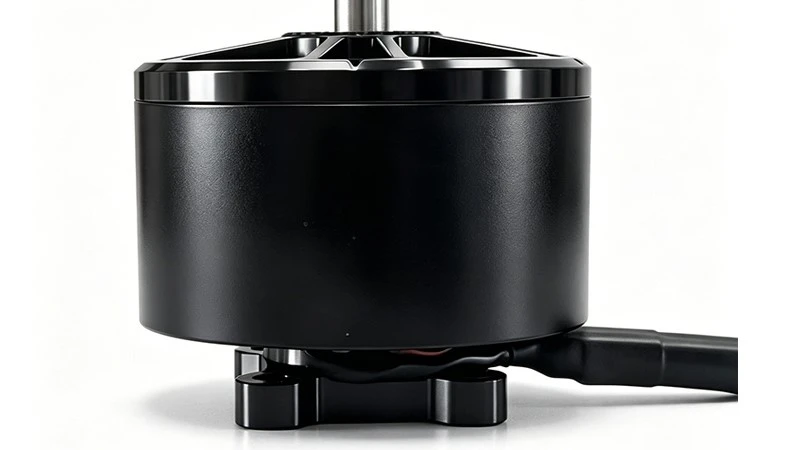
FPV drones mainly use brushless DC motors (BLDC), which have higher efficiency, longer lifespan, and more precise control compared to brushed motors. Brushed motors are mainly used in cheap toy drones.
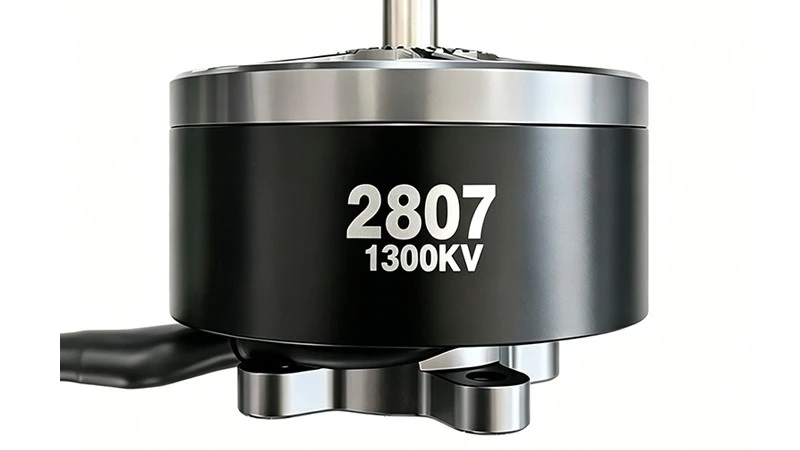
1.2 Motor dimension naming rules
01
The impact of size on performance:
02
Diameter increase
Torque enhancement, more suitable for driving large-diameter propellers, low-speed cruise stability improved
03
Increased height
improved power density and explosive power, enhanced pulling and rapid acceleration performance
04
The larger the size
the stronger the motor power and torque, capable of driving a larger propeller
1.3 Motor Structure
FPV motors mainly consist of the following components:
Stator
The stationary part, composed of laminated silicon steel sheets, with copper coils wound around it to generate a rotating magnetic field.
01
Rotor/Magnets
Rotating part, permanent magnets generate a fixed magnetic field
02
Windings
Copper coils, determining the KV value and current carrying capacity
03
Bearing
affects smoothness of operation and durability
04
Shaft
connects the motor bell and the propeller
05
1.4 Poles and Structure
FPV motors commonly feature 12N14P or 9N12P structures (N=stator pole count, P=magnet count), which affect efficiency and torque characteristics.
2. Detailed Explanation of Key Parameters
2.1 KV value (speed constant)
Definition: The KV value represents the theoretical speed (RPM/V) generated by a motor per 1 volt of input voltage under no-load conditions.
For example: A 2300KV motor connected to a 4S battery (16.8V fully charged), no-load theoretical speed = 2300 × 16.8 ≈ 38,640 RPM.
Physical determinants of KV:
| Factor | Impact on KV |
| The more turns in the winding | Lower KV (increased back EMF) |
| The fewer the number of turns in the winding | The higher the KV |
| The stronger the magnetic steel (such as N52) | Lower KV |
| The thicker the wire diameter | The higher the KV, the higher the efficiency. |
High KV vs Low KV:
| Characteristics | High KV | Low KV |
| Rotational speed | Fast | Slow |
| Torque | Small | Big |
| Response | Fast, agile | Smooth and controllable |
| Current consumption | Big | Small |
| Fever | High | Low |
| Endurance | Short | Long |
| Adapter propeller | Small diameter/small pitch | Large diameter/large pitch |
Core matching principle:Low KV with large propellers, high KV with small propellers.
2.2 Stator volume and torque
The volume of the stator can be calculated using the cylinder volume formula:Volume = π × (diameter/2)² × height
2207 vs 2306 Comparison:
| Model | Stator size | Stator volume | Features |
| 2207 | Φ22×H7mm | ≈2660mm³ | 6.6% larger in volume, higher peak power, and strong thrust in the high-speed range. |
| 2306 | Φ23×H6mm | ≈2494mm³ | The torque output is smooth and linear, with higher efficiency at medium and low throttle. |
2207 emphasizes strong thrust and stronger low-RPM torque, making it perfect for high-energy, fast-paced flying.
2306 is a well-balanced choice that provides smooth thrust and controllable response for most 5-inch FPV drones.
2.3 Thrust and Thrust-to-Weight Ratio
Thrust-to-weight ratio = Total thrust ÷ Gross takeoff weight.
Thrust-to-weight ratio requirements for different application scenarios:
| Application scenarios | Recommended thrust-to-weight ratio |
| Racing | 8:1 – 10:1 |
| Fancy/Freestyle | 6:1 – 8:1 |
| Long-endurance cruise | 3:1 – 5:1 |
Real-world case: In the 2025 Shenzhen FPV racing competition, the champion model adopted 2306-2400KV motors + 5045 three-blade propellers, achieving a thrust-to-weight ratio of 8:1 and accelerating to 100 km/h in just 1.2 seconds.
Selection formula:Single motor maximum thrust = Maximum Takeoff Weight (MTOW) ÷ Number of motors × 2.2~2.5
2.4 Current and ESC Matching
ESC selection principles:
ESC continuous current ≥ measured peak motor current × 1.2~1.3 times (reserve 20%-30% redundancy)
For example: Motor full load 40A → Recommended to choose 50A or 60A ESC
Advantages of the high-voltage solution: At the same power, the higher the voltage → the lower the current → the smaller the line loss → the lower the heat generation.
3. Selection Guide (by Rack Size)
3.1 Selection Process
Frame size
1
>>
Propeller size
2
>>
Motor size
3
>>
KV value
4
3.2 Recommended configurations for each size
| Drone frame size | Blade size | Recommended motor | KV Reference | Battery | Applicable scenarios |
| 75mm (1.2 inches) | 31-40mm | 0802, 0802 Evo | 19,000-25,000KV | 1S | Indoor practice |
| 1.6-2 inches | - | 1102, 1103 | 18,000-25,000KV | 2S | Park lightweight aerial photography |
| 2.5 inches | - | 1404 | 4,000-4,600KV | 3-4S | New‑bie Outdoor Freestyle |
| 3-3.5 inches | - | 1804, 2004 | 4,000-6,000KV | 4S | Constrained‑environment FPV Freestyle |
| 5 inches | 5 inches | 2207, 2306 | 1750-1950KV (6S) | 6S | Freestyle / Racing Compatible |
| 5 inches | 5 inches | 2205-2306 | 2100-2400KV (6S) | 6S | Racing / Aggressive Freestyle |
| 6 inches | 6 inches | 2206-2208, 2306 | 2,000-2,300KV (4S) | 4S | - |
| 7 inches | 7 inches | 2806.5, 2807, 2808 | 1,100-1,600KV (6S) | 6S | Long‑Endurance & Long‑Range |
Supplementary note:
- 2-inch quad: 1003, 1103, higher KV (e.g., 4600KV)
- 2.5-inch quad: 1404, 1507, KV 3000-5000
- 3-inch quad: 1806, 1804, KV 2500-3500
- 3.5-4-inch quad: 2004, 2006, KV 2000-3000
3.3 5-inch machine KV selection (6S has become the mainstream)
| Flight style | Recommend KV | Features |
| Freestyle / Aerial Photography | 1750-1950KV | Strong torque, stable image |
| Racing / Aggressive Freestyle | 2100-2400KV | Strong explosive power |
| Efficiency first | 1700-1800KV | Longer battery life |
4S and 6S correspondence: 1600-2100KV is suitable for 6S, 2300-2800KV is suitable for 4S.
4. Advanced Performance Factors
4.1 Torque
Torque determines whether the motor can change its speed quickly. Influencing factors include:
Larger stator volume → larger torque
Stronger magnetic steel → larger torque
Smaller air gap → larger torque
Wide stators (such as 2306) produce more torque, and high stators (such as 2207) have a higher RPM at high throttle.
4.2 Temperature and Heat Dissipation
High temperatures will cause the magnetic steel to demagnetize, leading to performance degradation.
High KV motors generate heat more easily than low KV motors.
The wider the stator → the larger the heat dissipation surface area → the better the heat dissipation.
4.3 Response time
Heavy rotor → Large moment of inertia → Slower response but smooth operation
Light rotor → Small moment of inertia → Sensitive response, faster braking
Small-sized motor → Lightweight → Fast acceleration and deceleration
5. Popular Motor Recommendations
| Use | Recommended models | Reference price | Features |
| 5-inch cost-effectiveness | EMAX ECO II 2207 1700KV | $14-16/each | Extremely high cost-performance ratio |
| 5-inch entry-level | iFlight Xing-E 2207 1800KV | $14-16/each | Balanced performance |
6. Common Selection Pitfalls
Only looking at KV without considering size:At the same KV, a larger stator motor can drive a larger propeller.
Blindly pursuing high KV: High KV consumes more power and generates more heat, making it unsuitable for long flight times.
The larger the motor, the better: Large motors are heavy, which actually reduces response and flight endurance.
Ignoring ESC matching: The ESC current must be 1.2-1.3 times greater than the motor's peak current.
Not paying attention to the thrust-to-weight ratio: Insufficient thrust will lead to poor control response, or even prevent takeoff.
Only looking at the rated KV: Even if the rated KV is the same, there may be significant differences in actual performance between different brands.
FPV Drone Motor Selection FAQ
KV is the theoretical RPM increase per 1 volt applied with no propeller load. Higher KV means faster spin but lower torque and higher current draw. The rule is: low KV for large props (e.g., 7-inch), high KV for small props (e.g., 3-inch). For a 5-inch drone, use 1600-2100KV for 6S, and 2300-2800KV for 4S batteries.
Follow this order: Frame size → Prop size → Motor size. Reference table (for 4S batteries):
Under 3″: 1105-1306, KV≥3000
4″: 1806/2204, KV 2600-3000
5″: 2205-2306, KV 2300-2600
6″: 2206-2306, KV 2000-2300
7″: 2506-2508, KV 1200-1600
Not necessarily. Higher KV gives more RPM and punch, but draws more current, runs hotter, and shortens flight time. If paired with large props, it may overheat and burn. Choose KV according to your style: racing → high KV, long-range → low KV, freestyle → medium.
For the same motor, 6S has higher voltage, so to keep similar power, KV on 6S should be about 0.7× the 4S KV. For example, on a 5″ drone, 2400KV for 4S → ~1700-1800KV for 6S. 6S runs lower current, less heat, and better efficiency – now the mainstream choice.
Thrust-to-weight = Total thrust ÷ Total takeoff weight. Single motor thrust from datasheets. Minimum is 2:1 (just to lift off), but practical recommendations:
Racing: 8:1 – 10:1
Freestyle: 6:1 – 8:1
Cruise/Cinematic: 3:1 – 5:1