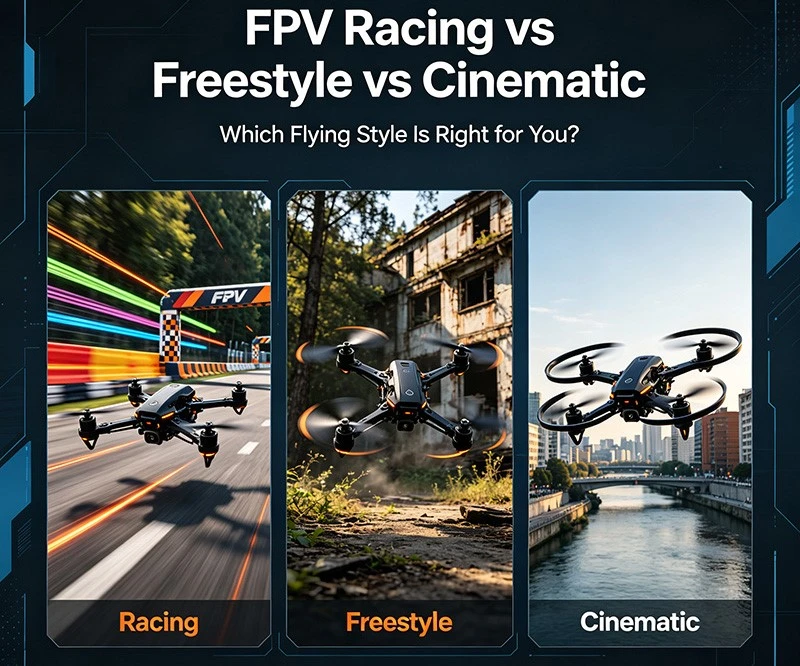
The same remote controller, the same joystick operations, but these three FPV flying modes-racing, freestyle, and cinematic-have almost nothing in common, from the hardware to the training methods and the judging criteria.
Many people who are new to FPV tend to confuse these three together-the video covers all look like high-speed, low-altitude, first-person exciting footage. But once you put on the flying goggles, you will find that they are completely three different sports. This article will explain these three types of FPV clearly from four dimensions: hardware, parameter tuning, venue, and skills, helping you judge exactly what you are watching and which one is more suitable for you to fly.
I. Overview of Three Types of FPV
| Comparison dimension | Racing | Freestyle | Cinematic |
| Core objective | Fastest lap time | Stylization techniques and fluency | Smooth, usable film and television images |
| Evaluation method | Timing / Finish Order | Style, flow, and movement execution | Image smoothness, lens quality |
| Typical dimensions | 5 inches | 5 inches | 2.5–7 inches |
| Full load weight | 250–500 g (from 250 g dry weight) | 550–800 g | 700 g–1.2 kg (long battery life version) |
| Motor KV (6S) | 1950–2200 KV | 1700–1960 KV | 1300–1700 KV |
| Camera load | Usually none, only FPV camera | GoPro or action camera | Action camera + possible dual camera |
| Flight time | 2–4 minutes | 3–6 minutes | 8–20 minutes |
| GPS | Rarely used | Optional | Standard configuration |
| Rack arm thickness | 3–4 mm, ultimate weight reduction | 5 mm+, blast resistance priority | Does not pursue extreme thinness and lightness |
| Representative Events/Organizations | MultiGP,DRL | Informal, style-driven | Informal, production driver |
II. Racing: Subtraction taken to the extreme
The essence of racing FPV is one thing: to pass through all the gates on a fixed track in the shortest time.
Hardware logic
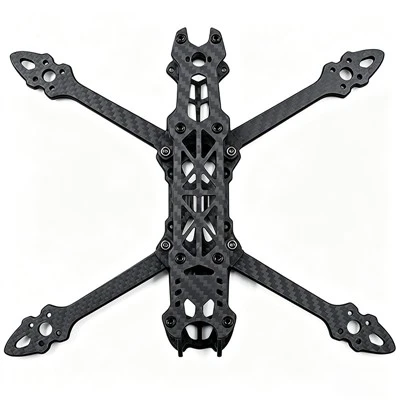
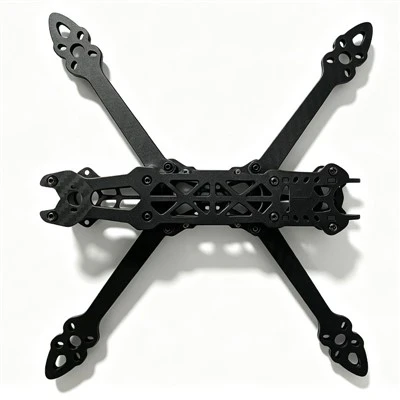
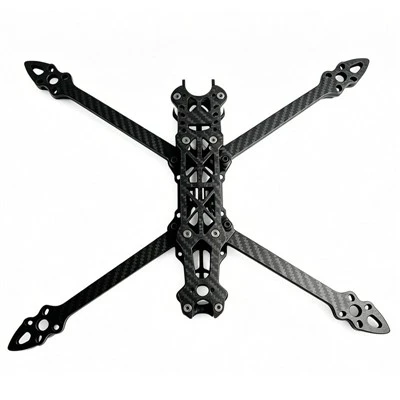
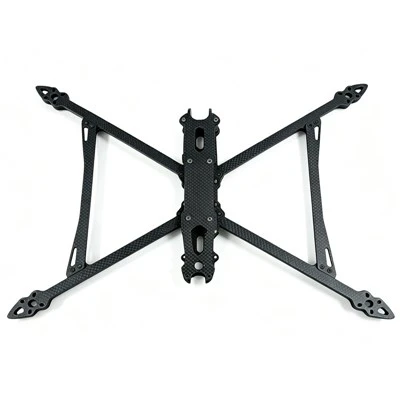
Everything in the design of a racing drone is about subtraction. The frame arms are usually only 3–4 mm thick, and many even feature cutouts to further reduce weight. A 5-inch racing drone frame itself may only weigh 50–70 g, while a freestyle drone frame of the same class weighs 100–130 g.
Parameter tuning characteristics
Racing Rates settings pursue center precision and fast roll response. Typical racing Rates are: Roll/Pitch 650–800°/s, Yaw 550–700°/s, with Expo around 0.2 to maintain linear response. The camera angle is usually tilted up to 30–45°, so that the horizon remains in the frame when flying forward at high speeds.
Core competency
Racing tests consistency and memory. With a fixed track, what racers need to do is repeat the same line until it becomes automatic, eliminating every millisecond of wasted throttle. If you like timers, rankings, and personal bests, the feedback from racing is the most direct.
III. Freestyle Hua Fei: Freedom Without Tracks
Freestyle is the most popular of the three disciplines in terms of participation. Its core is not speed, but performing stylish flight maneuvers in existing terrain.
Hardware logic
The weight of a freestyle drone is usually 550–800 g fully loaded, which is much heavier than a racing drone. The reason is simple: it needs to be crash-resistant. Freestyle drones often fly close to obstacles in terrains such as abandoned buildings, forests, and parking lots, so crashing is a common occurrence. Therefore, the frame arms are usually thicker than 5 mm, and it is also equipped with replaceable arms, 3D-printed guards, and a GoPro mount.
Parameter tuning characteristics
Freestyle rates are higher than racing rates, allowing pilots to quickly snap out rolls and power loops. Typical settings: Roll/Pitch 850°/s, Yaw 750°/s, Expo around 0.15. Camera angle is usually between 15–30°, balancing low-speed proximity flying and medium-speed maneuver transitions.
Core competency
What Hua Fei values most is actually the connection between tricks. Two technically perfect flips with an awkward pause in between look far worse than a regular trick smoothly connecting to the next. This is why Hua Fei is compared to skateboarding and snowboarding-it has a personal style, and every flyer will develop their own signature flying style.
IV. Cinematic FPV: Making manual flight look like automatic
The goal of FPV filmmaking is very clear: fly in Acro manual mode, but produce footage that makes it completely impossible for the audience to tell it is manual operation.
Hardware logic
The most iconic model in FPV cinema is the Cinewhoop-a quadcopter with ducted propeller guards. The ducts were originally designed for professional film sets, allowing the drone to safely approach actors and fly through indoor spaces. The trade-off is that the ducts add 30–50 g of weight and block some thrust, resulting in a top speed being limited to about 60 km/h.
simulator
The rates for cinematic FPV are the softest among the three genres. Referencing the cinematic configuration of the GEPRC CineLog35 (3.5-inch Cinewhoop): Roll/Pitch Center Sensitivity 40, Max Rate 420°/s, Expo 0.40; Yaw is lower, with a Max Rate of only 320°/s and Expo 0.30. The core purpose of this setting is to make the response near the center of the sticks extremely delicate, thereby eliminating any unnecessary jitter in the footage.
Core competency
Cinematic FPV tests an "invisible technology"-making full manual control look like automation. Racing pilots' mistakes are reflected in the timer, freestyle pilots' mistakes are reflected in crashes, and cinematic pilots' mistakes are reflected in "not being able to explain why the footage just isn't steady enough." A good cinematic FPV pilot will hide all joystick operations behind smooth footage.
V. Which school should you start with?
A common misconception is to have beginners decide on a direction when buying their first machine. But in reality, the basic joystick skills for the three types of FPV are completely identical-the mixed control of throttle, pitch, roll, and yaw in Acro mode is the common foundation for all disciplines.
A reasonable progression path is:

A practical suggestion:
Don't let your first real drone carry your most expensive camera. Cinematic FPV equipment concentrates the most expensive components-an O4 Pro video transmitter plus the matching goggles and action camera; a single beginner mistake could damage multiple high-priced parts. Use a durable, crash-resistant drone first to build muscle memory and spatial awareness before transitioning to cinematic equipment, and the learning cost will be much lower.
VI. Glossary of Essential Terms
| Terminology | Meaning |
| Acro Mode | Manual mode, no self-stabilization, the basic control method for all FPV genres. |
| Cinewhoop | Models with ducted propeller guards, the iconic platform for cinematic FPV |
| Expo | Remote control curve, the higher the value, the softer the response near the center of the joystick. |
| FPV | First Person View, First-person view flying |
| KV | The RPM per volt of a motor: high KV favors speed, low KV favors efficiency and smoothness. |
| MultiGP | The world's largest FPV racing organization, 30,000+ registered pilots, 500+ local chapters |
| Rates | The angular velocity (°/s) corresponding to the maximum joystick deflection determines the speed of roll and yaw. |
| RID | Remote ID, remote identification, mandatory for outdoor flights in most regions starting from 2026 |
VII. Emulator Selection Guide
VelociDrone
The most accurate physics, the first choice for racing pilots and MultiGP competitors, a one-time purchase for $23.
Liftoff
Most beginner-friendly, balancing racing and stunts, $19.99, cross-platform (Windows/macOS/Linux).
TRYP FPV
Best image quality, suitable for practicing smooth cinematic FPV flying.
DRL Sim
Racing exclusive, MultiGP official partner simulator.
Orqa FPV.SkyDive
Free entry option.
A common recommended combination is: VelociDrone for racing, Liftoff for freestyle. If the budget is limited, buying just Liftoff is enough.
VIII. Budget Reference
One of the practical questions readers care about most is "how much will it cost". The following data is from the 2026 building guide:
| Budget range | Suitable direction |
| $200–300 | Entry-level 5-inch, park flying, basic freestyle flying |
| $300–500 | Intermediate flower flying, abandoned building flying |
| $500–700 | Advanced Flower Flying, Movie FPV (including GoPro payload) |
| $600–1,500+ | Complete racing setup (including goggles, battery, and charger) |
The "drone itself" for racing can be controlled within $200–500, but the goggles and batteries are the major hidden costs-a set of entry-level goggles costs between $80–450, and 4–8 batteries add another $100–250.
FAQ
Q: What is the main difference between racing, freestyle and cinematic FPV drone?
A: Racing FPV focuses on fastest lap time on fixed gates; Freestyle pursues smooth tricks and creative maneuvers; Cinematic FPV aims to capture stable, movie-quality footage. They differ greatly in frame, motor KV, camera setup and flight tuning.
Q: Which FPV type is best for beginners to start with?
A: We recommend starting with simulator training first. Liftoff is a great pick for new pilots. Do not buy high-end cinematic drone at first; choose crash-resistant freestyle or basic racing quad to build your flying skills.
Q: What motor KV should I choose for racing / freestyle / cinematic FPV?
A: Racing:1950–2200KV (6S); Freestyle:1700–1960KV (6S); Cinematic:1300–1700KV. Higher KV delivers faster speed; lower KV brings smoother and longer-endurance flight.
Q: What is Acro Mode, do I need it for all three FPV styles?
A: Yes. Acro Mode is the manual flight mode without auto stabilization. It is the fundamental control mode required for racing, freestyle and cinematic FPV.
Q: What simulator should I buy to practice FPV?
A: Liftoff is the most balanced choice for beginners. VelociDrone has superior physics for racing pilots. TRYP FPV is ideal for cinematic smooth flight practice.
Q: Can one drone be used for both racing and freestyle?
A: It can work but not optimal. Racing drones are lightweight and fragile; freestyle frames are thicker and crash-resistant. Hardware and rates tuning are optimized for different purposes.
Q: Is GPS needed for racing or freestyle FPV flight?
A: Racing FPV almost never uses GPS. Freestyle is optional. Cinematic FPV usually has GPS as standard for safety and return-to-home function.
Q: What size drone is most common for the three FPV styles?
A: Racing & Freestyle mostly use 5-inch quads. Cinematic FPV ranges from 2.5 inch to 7 inch, 3.5-inch Cinewhoop is widely popular.