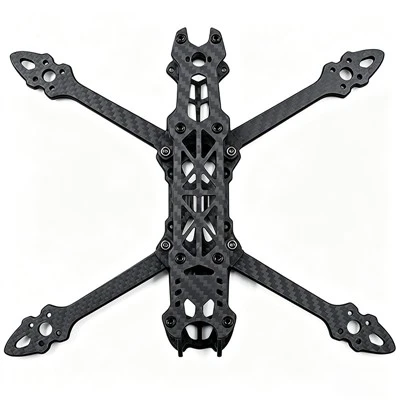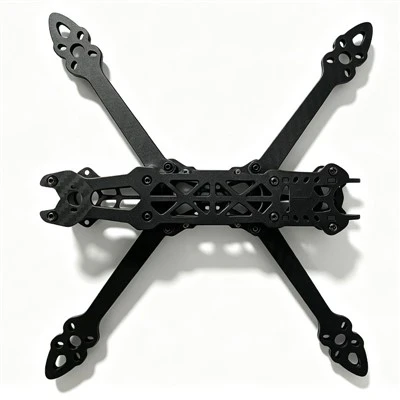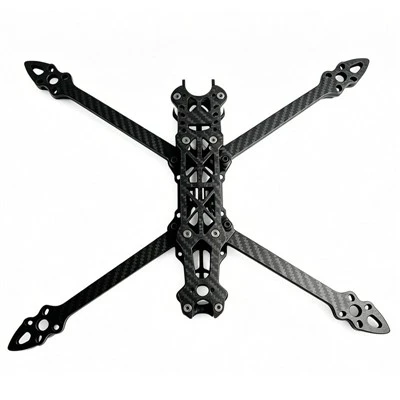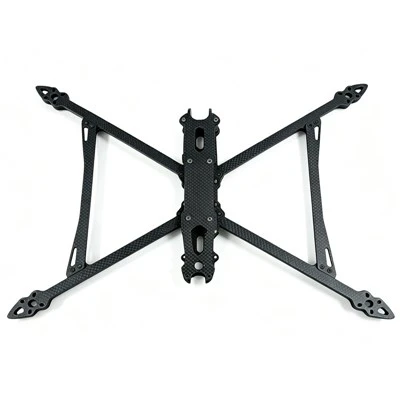

For an individual hobbyist building a single freestyle quadcopter, minor variations in hardware rarely cause major headaches. If a replacement arm requires a few strokes of a needle file to fit, or if a new motor runs slightly warmer than the original three, a solo pilot can tweak a setting in Betaflight and get back in the air.
When scaling from a single workbench to a commercial, industrial, or institutional fleet of 50, 500, or 5,000 unmanned aerial vehicles (UAVs), those minor hardware discrepancies transform into systemic operational failures.
Fleet operators, defense contractors, and aerial mapping enterprises rely on predictability. Every airframe in a production run must share identical flight characteristics, vibration profiles, and mechanical tolerances. Achieving this level of reliability does not start at the final assembly line; it begins at the raw material and component manufacturing level. Specifically, it depends on strict batch-to-batch consistencyin CNC carbon fiber frames and brushless motors.
The Hidden Cost of "Close Enough" Hardware in Fleet Operations
Sourcing drone components from fragmented retail channels or unvetted trading companies often introduces silent variables into a build. Two batches of frames or motors may share the same product listing and visual appearance while differing significantly in physical composition.
When hardware drifts between production runs, fleet operators face three immediate bottlenecks:
- Broken Master Tunes: Modern flight controllers rely on tightly calibrated PID loops and dynamic notch filters to keep airframes locked in. A slight shift in frame stiffness or motor response alters the natural resonant frequency of the quadcopter, turning a proven "master tune" into a source of mid-throttle oscillations or motor overheating.
- Assembly Line Delays: When CNC hole tolerances drift by even 0.2 millimeters, technicians spend valuable labor hours forcing standoffs into place, reaming out motor mounts, or shimming uneven arms.
- Spare Parts Incompatibility: Field maintenance depends on true modularity. If a replacement arm from Batch B does not align cleanly with a main plate from Batch A, field repairs stall and entire airframes are grounded.

Carbon Fiber Consistency: Beyond the Surface Weave
Carbon fiber composite sheets are not uniform commodities. Two plates labeled "3K Twill Matte" can exhibit vastly different mechanical properties depending on the precursor fiber grade, resin chemistry, and curing cycle used during production.
1. Prepreg Fiber Grade and Resin Ratios

The structural rigidity of an FPV frame dictates how cleanly gyro data reaches the flight controller. High-grade carbon fiber sheets-such as authentic Toray T300 or T700 composites-use carefully controlled pre-impregnated (prepreg) resin ratios, typically hovering around 35% to 40% resin by weight.
Lower-tier manufacturers frequently dilute pure carbon layers with fiberglass cores or vary resin ratios between press cycles to cut costs. A batch with excess resin becomes heavier and more brittle, while a resin-starved batch suffers from poor interlaminar shear strength, leading to premature delamination under heavy payload loads or hard landings. Maintaining identical layup schedules (the exact orientation of 0°, 45°, and 90° fiber plies) across every sheet ensures every arm flexes identically under load.
2. Thickness Tolerances and CNC Milling Precision
Carbon fiber sheets are cured under heat and pressure, which can produce slight thickness variations if hydraulic press platens are not calibrated. For a 5mm or 6mm drone arm, an unmonitored variance of ±0.3mm changes both the arm's cross-sectional stiffness and the required screw length for motor mounting.
Precision manufacturing requires strict incoming plate inspection before a sheet ever touches a CNC router:
- Calibrated Plate Thickness: Holding thickness tolerances within ±0.1mm guarantees that hardware kits, press-nuts, and 3D-printed TPU mounts fit identically across every batch.
- Tooling Wear Management: Diamond-coated CNC router bits wear down as they cut through abrasive carbon fibers. If a factory runs worn bits too long, hole diameters shrink and edges fray. Automated tool-change schedules and post-machining optical inspections ensure M2 and M3 mounting holes maintain exact center-to-center spacing from the first frame to the ten-thousandth.

3. Predictable Resonance Profiles

Every drone frame has a natural acoustic and mechanical signature. When an engineering team spends weeks tuning a 7-inch long-range platform or a 10-inch heavy-lift rig, their filter settings are tailored to that specific frame's stiffness. Consistent carbon fiber density and CNC geometry ensure that Frame #1 and Frame #500 produce the exact same gyro noise floor, eliminating the need to individually blackbox-tune every unit off the line.
Brushless Motor Matching: Precision at High RPM
If the carbon frame is the skeleton of the fleet, the brushless motors are its cardiovascular system. Even microscopic inconsistencies inside a motor bell or stator assembly amplify dramatically when spinning at 20,000 to 40,000 RPM.
1. KV Variance and Copper Winding Consistency
A motor's KV rating-its RPM per volt under no load-is determined by the number of copper turns around each stator tooth and the strength of the magnetic field. In mass production, inconsistent winding tension or slight variations in copper wire gauge can cause KV ratings to drift by 5% or more between batches.
If an operator replaces a damaged motor on a heavy-lift rig with a unit from a higher-KV batch, that corner of the aircraft will generate more thrust at the same throttle command. The flight controller will constantly compensate by varying ESC outputs, resulting in uneven battery drain, asymmetric motor temperatures, and yaw drift during hover. Factory-matched motor batches hold KV variance within tight tolerances (typically ±1% to ±2%) by using automated CNC winding machines and batch-tested copper wire.

2. Magnet Grade and Air-Gap Tolerances

High-performance FPV motors rely on curved neodymium magnets-such as N52H or N54H grades-to maximize torque and thermal resistance. Substitutions in magnet grade or inconsistent adhesive thickness during magnet installation directly alter the air gapbetween the spinning magnets and the stationary stator laminations.
A wider air gap reduces magnetic flux density, lowering overall efficiency and forcing the motor to draw more amps to maintain hover. Consistent bell machining and automated magnet-gluing jigs keep the air gap uniform across every motor in a production run, ensuring predictable amp draw and flight times across the entire fleet.
3. Dynamic Balancing and Bearing Longevity
Unbalanced motor bells are the primary source of high-frequency vibration ("Jello") in onboard optical and thermal sensors. While hobbyist motors sometimes skip individual balancing, fleet-grade motors undergo single-plane or dual-plane dynamic balancing at the factory.
Pairing balanced bells with identical Japanese or high-grade stainless steel bearings (such as EZO or NMB) from verified batches ensures consistent rotational friction and predictable service intervals. Maintenance crews can schedule preventative bearing replacements based on logged flight hours rather than reacting to unexpected mid-mission seizures.

The Synergy of Matched Frames and Motors
Carbon frames and brushless motors do not operate in isolation; they form a coupled mechanical system. The motor generates rotational vibration, and the carbon arm transmits or dampens that energy on its way to the flight controller's gyroscope.
When a single manufacturing partner controls both CNC carbon fabrication and motor assembly-or enforces unified quality standards across both lines-fleet operators gain distinct operational advantages:

- Zero-Touch Flight Controller Flashing: Engineers can flash an identical CLI dump (PIDs, rates, and RPM filter settings) onto every flight controller on the assembly line with confidence that every aircraft will fly stably on its maiden test hover.
- Accurate Fleet Telemetry: Battery consumption curves, hover throttle percentages, and ESC temperature thresholds remain uniform across all units, allowing automated ground-control software to flag genuine mechanical anomalies early.
- Streamlined Inventory Management: Procurement teams no longer need to segregate spare parts by production date or serial batch. Any arm, top plate, or motor pulled from the warehouse shelf is guaranteed to mate cleanly with any airframe in the field.
Auditing Your Drone Supply Chain: A Procurement Checklist
For technical directors and procurement managers evaluating FPV hardware factories, verifying batch-to-batch consistency requires looking past marketing datasheets. Before committing to a volume production run, request documentation and verification on the following benchmarks:
| Component Area | Verification Metric | Target Fleet Standard |
|---|---|---|
| Carbon Fiber Sheets | Material Certification & Layup | Verified Toray T300/T700 prepreg; documented ply orientation |
| CNC Frame Machining | Dimensional Tolerance Report | ±0.1mm on plate thickness; ±0.05mm on critical mounting holes |
| Stator & Windings | Batch KV Consistency | Automated CNC winding; KV variance within ±2% across batch |
| Motor Bells | Dynamic Balance Grade | Individual factory balancing; documented residual unbalance limits |
| Traceability | Batch Serialization | Laser-etched batch codes on motor bells and packaging for QA tracking |
Key Questions to Ask Your Manufacturing Partner:
Do you lock raw material suppliers for repeat orders? Ensure your factory does not switch carbon prepreg vendors or magnet suppliers between your initial prototype order and your full-scale production run.
What is your incoming QC process for carbon plates and bearings? Confirm that raw sheets are measured for thickness and flatness before CNC cutting begins.
Can you supply matched motor sets from a single winding run? Ordering spare motors from the exact same production batch as your primary fleet build guarantees seamless field replacements.
Conclusion: Reliability Starts at the Factory Floor
In commercial and industrial drone operations, hardware consistency is the foundation of mission success. While software filters and advanced flight controllers can mask minor mechanical flaws in a single test unit, scaling a fleet exposes every shortcut taken during manufacturing.
By prioritizing batch-to-batch uniformity in CNC carbon fiber composites and precision-wound brushless motors, fleet operators eliminate costly assembly bottlenecks, preserve finely tuned flight performance, and ensure every spare part on the shelf performs identically to the original. When your supply chain is built on repeatable manufacturing tolerances, your team spends less time troubleshooting hardware-and more time flying missions.
FAQ
Q: What risks will inconsistent batch hardware bring to my drone fleet?
A: Inconsistent carbon frames and motors shift the resonant frequency and thrust output. Your unified PID master tune will fail, assembly work will slow down, and spare parts from different batches cannot be swapped directly, which grounds your UAVs during field maintenance.
Q: What tolerance standard should I require for carbon fiber frames for fleet projects?
A: For mass drone fleets, we recommend carbon plate thickness tolerance within ±0.1mm, and critical mounting hole tolerance within ±0.05mm. All carbon sheets should use certified prepreg carbon with fixed ply layup schedules.
Q: What KV variance is acceptable for matched fleet motors?
A: For commercial and industrial drone fleets, we control KV variance within ±2% for the same batch. Hobby-grade motors usually allow a wider tolerance above 5%, which is not suitable for fleet deployment.
Q: Why does the air gap of brushless motors affect fleet consistency?
A: Uneven air gaps change magnetic flux density. Motors with different air gaps draw different current at the same throttle, leading to inconsistent hover efficiency, uneven temperature rise and yaw drift across the fleet.
Q: Can I use one master PID tune for all drones if I order matched frames and motors from the same batch?
A: Yes. Matched mechanical components deliver identical vibration and resonance characteristics. You can flash one unified PID / filter setting to all flight controllers, without tuning each aircraft individually.
Q: How do you guarantee batch traceability for drone components?
A: Every motor bell and carbon frame plate is laser-etched with a unique batch code. We keep raw material certificates, CNC inspection reports and motor test logs for each batch for your audit.
Q: What is the difference between hobby balancing and fleet-grade dynamic balancing for drone motors?
A: Hobby motors often skip formal dual-plane dynamic balancing. Fleet-grade motors complete dynamic balancing individually, to suppress high-frequency vibration and eliminate camera jello for payload sensors.
Q: If I have existing drone fleets, can you supply spare parts that match my old batch specifications?
A: Yes. If you provide the original batch number, drawing or sample, we can lock the same raw material, layup and machining process to produce compatible spare parts for replacement.
More industry knowledge about FPV drones