I. Why 10 inches is not a "magnified version of 5 inches"

10-inch long-range FPV is a completely different machine category. A 5-inch freestyle FPV drone weighs 350–500g with a flight time of 4–6 minutes; whereas a qualified long-range 10-inch drone should aim for a cruising time of over 15–25 minutes and a controllable distance of over 8–15 kilometers. The component selection logic of the two has almost no overlap.
The core contradiction of this machine lies in the fact that excess thrust is the enemy of efficiency. The power system of a typical 10-inch machine produces thrust far exceeding what is required for hovering at 100% throttle, yet 90% of the flight time is spent cruising at 30–40% throttle. If you select the motor and ESC based on maximum thrust, you pay the price in weight, cost, and current consumption, only to gain performance that will never be used.
II. Core Design Decisions
2.1 Why choose 8S instead of 6S
From an electrical perspective, the nominal voltage of an 8S LiPo is 29.6V, with a fully charged voltage of 33.6V, which is a 33% increase compared to the 22.2V nominal voltage of a 6S. Under the same power demand, an increase in voltage means a proportional decrease in current. Calculating based on the typical cruising power of 300–500W for a 10-inch aircraft, a 6S system requires a total current of about 13–22A, while an 8S system requires only about 10–17A. The direct benefits brought by the reduced current are: less heat generation in the motors, ESCs, and wiring, a smoother voltage curve, and a more linear throttle response.
More critically is the cost of the ESC. Real-world test data shows that the 3115 900KV motor, when paired with HQ 10×5×3 propellers on 6S (25V), reaches a peak current of 84.4A, far exceeding the continuous and burst ratings of a 60A ESC. If you go the 6S route, you must use an 80A or even a 100A ESC, which significantly increases the cost. In contrast, the operating current of the same class of motor on 8S is significantly lower, and a 65A ESC can safely cover it.

But 8S also comes with a cost: heavier batteries, higher charger requirements, and the voltage compatibility of the flight controller and ESC needs to be strictly confirmed.
2.2 X8 Coaxial: The Real Trade-off Between Safety Redundancy and Efficiency
The main motivation for choosing the X8 configuration is redundancy safety: there is one motor above and one below each arm, so there is still enough thrust to maintain flight or even return home in the event of a single motor, propeller, or ESC failure. For a large machine with a total cost that may exceed $1000, this logic is reasonable.
However, the efficiency cost of X8 needs to be addressed. Community tests and manufacturer data provide a range: the efficiency loss of a coaxial configuration is approximately 10–20%, depending on the propeller size, spacing, and the matching of the upper and lower propellers. An ArduPilot community user optimized coaxial efficiency and balanced yaw torque by using a larger pitch on the bottom propellers (5.5" vs. 4.5" on top), ultimately compressing the efficiency loss to 5–7% in a specific wind tunnel configuration.
This means that the choice of X8 essentially trades 10–20% of battery life for single-point failure survival capability. For machines pursuing extreme endurance, traditional quadcopters remain a more efficient choice; but for a long-endurance platform that you fly kilometers away and has a high cost per mission, the redundancy value of the X8 may outweigh the loss in battery life.
If you go with the X8 route, there is a configuration point that is easily overlooked: the flight controller must support 8-way motor output, and the ESCs can be distributed as two 4-in-1s (each side of the frame sharing one 4-in-1), making the wiring cleaner, and if one ESC fails, the other side can still work.
III. Component Selection
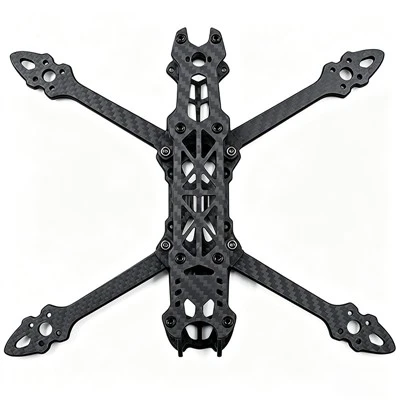
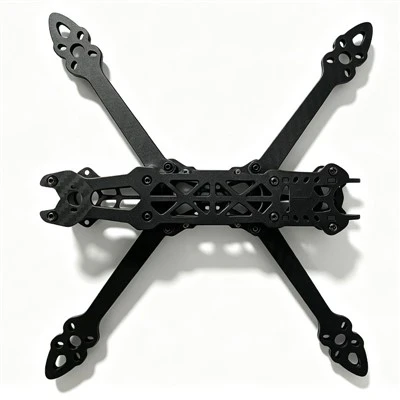
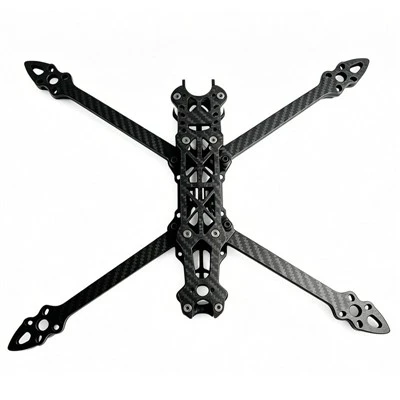
3.1 Drone frame: Anti-resonance is the top priority

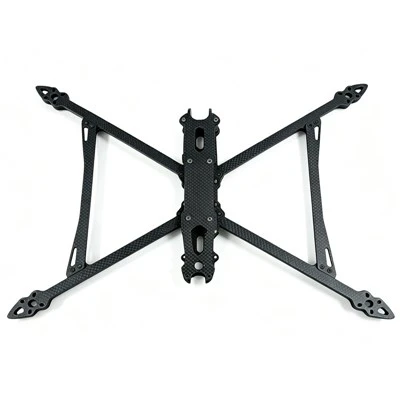
The biggest engineering challenge for 10-inch frame drones is arm resonance. After the length of the arm from the center to the motor increases to the 10-inch level, any slight bending and vibration will be amplified, directly interfering with the flight controller's gyroscope, leading to degraded flight performance or even loss of control.
The AOS UL10 V5 vertical truss structure is recommended, which has been verified on large-scale film and television lifts. Other noteworthy solutions on the market include:
GEPRC Mark4 10-inch
7mm arm thickness + 3mm vertical reinforcement rod, extremely strong structural rigidity, can carry a 3kg payload, with an empty weight of only 270g.
iFlight Helion 10-inch
A-Frame design, officially stated to have been optimized over several months to balance stability, weight, and rigidity, focusing on solving the torsion and vibration issues of large drones.
RMRC Benchmark-LR 10-inch
6mm main arm + 2mm vertical reinforcement rod interlocking structure, specifically designed for the suppression of high-frequency resonance and motor vibration.
Selection key points: A vertical reinforcement structure (truss or reinforcement bar) is almost essential at the 10-inch level. Pure flat plate arms will almost inevitably suffer in resonance control. In terms of weight, a qualified 10-inch long-endurance frame should be between 270–400g, and exceeding 450g will significantly squeeze the battery weight budget.
3.2 Motor: Wide stator + low KV is key
The core feature of long-endurance motors is not "maximum thrust", but efficiency at cruise throttle. Wide-stator motors (such as 3110, 3115, 3215) can produce greater torque at low RPMs, which is exactly the characteristic needed when cruising at 30–40% throttle. Narrow-stator freestyle motors (2207, 2306) have fast throttle response, but their efficiency at the cruise point is very poor.
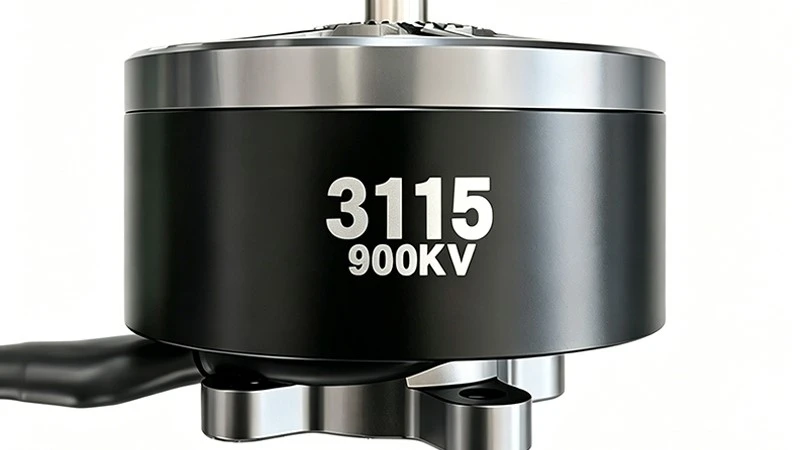
KV selection is directly linked to propeller diameter and voltage. For a 10-inch prop + 8S, 650–750KV is a reasonable range.Recommended motor comparison data:
| Motor | Stator | KV | Weight | Peak current (8S) |
| GEPRC EM3215 | 32×15 | 750 | 122g | 61A |
| BrotherHobby V4 32.5-15 | 32.5×15 | 665 | 121g | 53A |
| BrotherHobby Avenger | 32×20 | 700 | 140g | 73A |
It is worth noting that the actual measured peak current of the BrotherHobby V4 under 8S is only 53A, which indicates that a medium-to-low KV motor combined with a reasonable propeller can significantly reduce the pressure on the ESC.
3.3 ESC: 65A 4in1 ×2 vs Single 80A
My choice is 2× Foxeer Reaper 65A 4in1 (65A continuous / 100A burst / 3–8S / BLHeli32). This solution is reasonable under the X8 configuration: each 4in1 drives 4 motors on one side, the wiring is simple, and a single unit failure will not cause the entire aircraft to fail.
But there is an easily overlooked risk here: if the motor's peak current approaches or exceeds the 65A burst value under extreme conditions, the ESC may overheat and derate under continuous high load. Measured data shows that the 3115 900KV can reach a peak current of 84.4A on 6S; although the current will significantly decrease on 8S, you should still verify the measured current of the target motor with your actual propeller and voltage combination when selecting, rather than just looking at the motor's nominal "6S/8S compatible" rating.
Suggestion: If the budget allows, consider upgrading the single 4-in-1 to the 80A class (such as the Foxeer Reaper 80A) to leave room for current headroom. The continuous rating of the ESC should be at least 20–30% higher than the measured peak.
3.4 Flight Controller: Native 8S support + enough UARTs
The selection of 8S-compatible flight controllers is indeed limited. I chose the Matek H7A3-SLIM (8S input / 8 motor outputs / H7A3 / ICM42688P / 128MB blackbox / CAN / 6 UART), which offers outstanding cost-performance.
However, it is necessary to pay attention to the BEC power supply margin. Matek's 9V/2A output might be just enough for digital video transmitters like Walksnail Avatar GT, but it may approach its limit under high load or high-temperature environments. If using a digital video transmitter with high power consumption, it is recommended to use an external independent BEC, or choose a flight controller with a higher BEC output (such as Foxeer H7's 10V/2A or BrainFPV Radix 2 HD's 9V/2A).
Another easily underestimated selection factor is the coordination between the barometer and GPS. During long-endurance flight, altitude hold and return-to-home accuracy are highly dependent on the quality of the barometer. Both SPL06 and DPS310 are excellent choices, but the installation location (avoiding heat-generating components and airflow disturbances) is more important than the chip model.
3.5 Battery: LiPo is the starting point, Li-Ion is the endgame
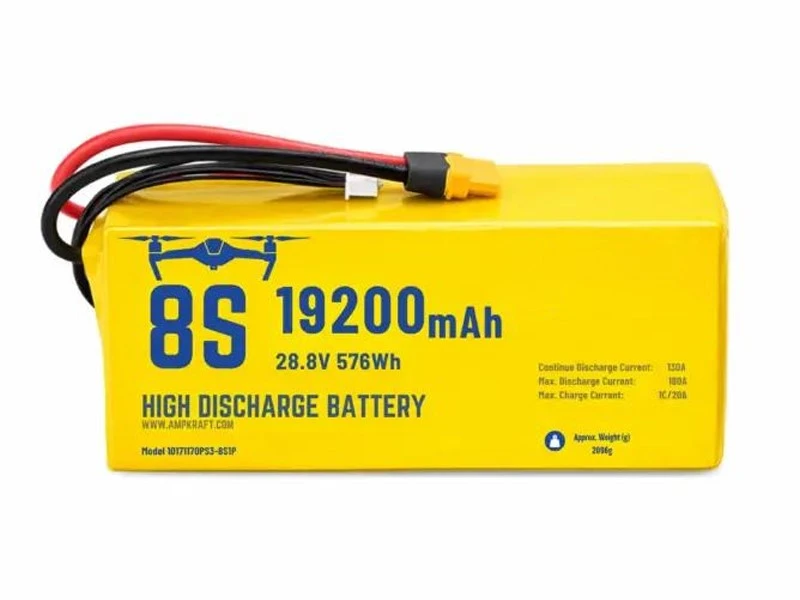
My plan is to first test with the CNHL 5200mAh 8S LiPo, and then switch to 8S2P/8S3P 21700 Li-Ion. This path is reasonable, but the choice of Li-Ion requires more detailed calculations.
The core advantage of 21700 lithium-ion batteries is energy density. Taking the Molicel P42A (4200mAh, about 70g/cell) as an example, an 8S2P configuration provides 8.4Ah, a nominal 29.6V, and a total energy of about 249Wh, with a battery pack weight of about 1.2kg (including nickel strips and packaging). In contrast, a LiPo battery with the same energy may weigh over 1.8kg. In long-endurance scenarios, this 600g difference directly translates into several minutes of extra flight time.
But Li-Ion has three limitations that must be accepted:
Voltage sag is significant:
each cell may experience a voltage drop of 0.5–1.0V under cruise current, and even more at full throttle. Flight planning must revolve around a stable cruise throttle, rather than burst acceleration.
Lower discharge cutoff voltage:
Li-Ion can be safely discharged to 2.5V/cell (LiPo is 3.3V), and the usable voltage range of a 6S system is from 18.0V to 15.0V. This means the low voltage alarm threshold of the flight controller needs to be reset.
Assembly quality determines everything:
if there is a cold weld in the hand-spot-welded nickel strip, it will form a high-resistance hot spot under high load, leading to a sharp increase in voltage drop or even fire. Without reliable spot-welding equipment and experience, it is recommended to purchase a finished battery pack.
3.6 Propeller: Two-blade is the default answer for long endurance
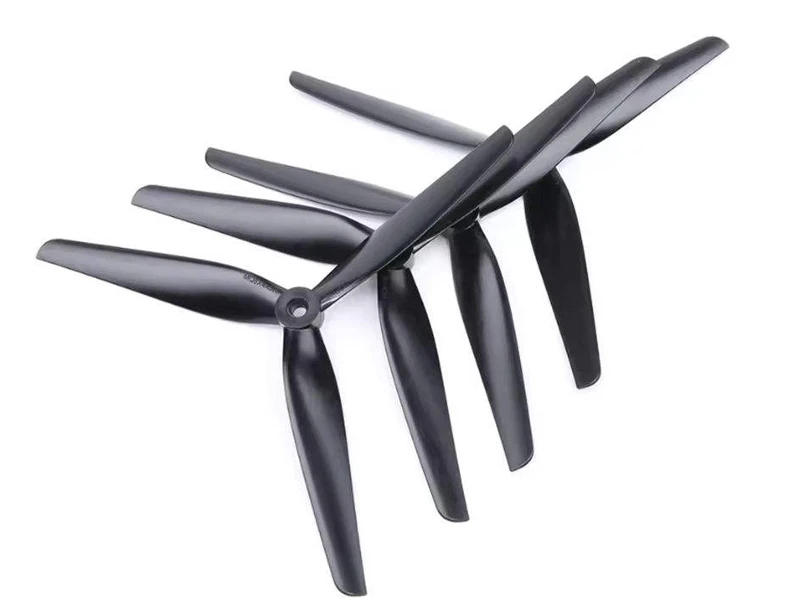
The logic of long-endurance propellers is completely different from that of freestyle propellers. Two-blade propellers are superior to three-blade and four-blade propellers in cruising efficiency, because fewer blades mean less drag during forward flight and lower current consumption. The community consensus is very clear: two-blade propellers are the "long-endurance choice", used in 7-inch and 10-inch builds, where efficiency takes precedence over agility.
From the data, the efficiency loss of a three-blade propeller compared to a two-blade one is about 10–15%. For a machine with endurance as its core metric, this gap is decisive.
3.7 Image Transmission and Receiver: The Trade-off Between Digital and Analog

Digital image transmission prefers high-definition picture quality, but it must be admitted that analog systems can achieve longer distances at a lower cost.
This trade-off is real. Digital video transmission experiences obvious image quality degradation and increased latency at the edge of the signal, whereas the signal degradation of analog video transmission is progressive-you can continue flying through the static until it is completely lost. For true long-range missions (15km+), 1.2G/1.6G analog video transmission remains the benchmark for reliability. Models like the iFlight X413 adopt the combination of 8S + 1.2G/1.6W VTX + ELRS 868/900MHz, with a clear positioning.
If you insist on digital video transmission, antenna selection and installation position are more important than transmission power. The GPS and magnetometer should be installed on an independent mount above the carbon fiber, away from the video transmission antenna and power lines.
In terms of receivers, ELRS 900MHz is superior to 2.4GHz in long-range penetration and diffraction, but 2.4GHz has a higher data rate within line-of-sight. Dual-band ELRS receivers (2.4G + 900MHz) are the current optimal solution, which can automatically switch according to the flight phase.
IV. Systematic Thinking on Safety and Redundancy
The X8 configuration provides redundancy for single motor/propeller/ESC failures, but redundancy is not free. You need:
Flight controller mixing configuration:
The motor allocation matrix of X8 is different from that of quadcopters, and both Betaflight and ArduPilot have native support, but the parameter configuration needs careful verification.
ESC fault isolation:
If two 4-in-1 ESCs are used, when one fails, the other can still drive 4 motors. However, the flight controller needs to be able to recognize and redistribute the thrust. This is achieved in Betaflight through the "motor fault detection" feature, and the configuration complexity is relatively high.
Return-to-home strategy:
The return distance after a single point of failure must be included in the flight planning. If you lose a motor at 10km away, is the remaining thrust sufficient to return? This depends on the current payload and battery margin, and requires a conservative estimate before the flight.
An easily overlooked safety item: the plug-in spark of the 8S system. A fully charged 8S battery at 33.6V may generate a significant spark at the moment of connection, causing an impact on the ESC and flight controller. Using an XT90-S anti-spark connector is a basic requirement and should not be omitted.
V. Summary: 8S + X8 + anti-resonance frame is the correct framework, but details determine success or failure.
The three core decisions-8S, X8, and the vertical truss frame-all have sufficient engineering justification. 8S reduces current and lightens the load on the ESC; X8 provides redundant safety; the vertical truss solves the resonance issue at the 10-inch level. This framework is robust.
What truly determines success or failure is the execution of details:
Does the rated value of the ESC have enough margin to handle the measured peak current?
Does the BEC power supply meet the continuous demand of the digital image transmission?
Has the X8 hybrid control and return-to-home logic after failure been seriously tested?
Whether the assembly quality of the Li-Ion battery pack is reliable?
Did the propeller choose the two-blade scheme with optimal efficiency?
The engineering threshold for a 10-inch long-endurance FPV is an order of magnitude higher than that of a 5-inch one, but this is precisely where its value lies-the optimization of every gram of weight, every ampere of current, and every decibel of vibration will directly translate into returns in flight time and mission radius.
FAQ
Q: What is the fundamental difference between a 10-inch long-range FPV drone and a 5-inch freestyle quad?
A: A 10-inch long-range FPV drone is not a scaled-up 5-inch freestyle rig - it's a different class of machine. A 5-inch freestyle quad weighs 350–500g and flies for 4–6 minutes, while a well-built 10-inch long-range platform should target 15–25+ minutes of cruise time and 8–15km of controllable range. The component selection logic barely overlaps. The key difference: a 10-inch platform's powertrain must be designed around efficiency at cruise throttle (30–40%), not maximum thrust. Wide-stator motors, low KV, bi-blade props, and Li-Ion batteries are the defining features of a long-range platform - none of which are considerations in freestyle quad selection.
Q: What are the real advantages of an 8S system over 6S for a 10-inch long-range build?
A: The core advantage of 8S is significantly lower current at the same power demand. An 8S LiPo at 29.6V nominal is 33% higher voltage than 6S at 22.2V, meaning current drops proportionally by roughly 25% for the same power. The direct benefits: less motor and ESC heat, flatter voltage curves, and lower wiring losses. From an ESC sizing perspective, bench data shows a 3115 900KV motor drawing 84.4A peak on an HQ 10×5×3 at 25V (6S) - well above a 60A ESC's continuous and burst ratings. Going 6S forces you into 80A or even 100A ESCs, significantly raising costs. On 8S, equivalent motors draw substantially less current, making 65A ESCs safe. But 8S has trade-offs: heavier batteries, higher charger requirements, strict voltage compatibility checks for FC and ESC, and the added battery weight can partially offset the voltage advantage.
Q: How much efficiency does an X8 coaxial configuration actually lose? Is the redundancy worth the range sacrifice?
A: The X8 efficiency loss is real, but the exact figure depends on prop size, spacing, upper/lower prop matching, and flight environment. ArduPilot community bench data puts the range at 10–20% for conventional coaxial setups, primarily due to reverse vortex interference between the rotors. However, optimized configurations can significantly narrow that gap - one community member achieved 5–7% loss in a duct-with-inlet configuration. For a platform costing over $1,000 and flying kilometers away, the single-motor/prop/ESC fault survival capability X8 provides usually outweighs a 10–20% range penalty. But for pure endurance records, a traditional quad remains the more efficient choice.
Q: What KV range should I choose for a 10-inch long-range build? Is 650–750KV reasonable on 8S?
A: For a 10-inch prop on 8S, 650–750KV is a sound range. The logic: you need the motor running at its efficient RPM range at 30–40% cruise throttle. Narrow-stator freestyle motors (2207, 2306) spin up fast but have poor efficiency at low-RPM cruise; wide-stator long-range motors (3110, 3115, 3215) generate more torque at low RPM - exactly what's needed for swinging a 10-inch prop at cruise throttle. Take a 3115-class motor: 900KV on 6S is the "flight-time priority" choice, while on 8S you should drop to 650–750KV. The RC in Power AOS Supernova 3220 offers 700KV (8S) and 925KV (6S) versions, each optimized for efficiency and peak performance respectively. BrotherHobby V4 32.5-15 at 665KV draws only 53A peak on 8S - showing that moderate KV with matched props can significantly reduce ESC stress. KV must match prop size and voltage: high KV with large props causes motor overheating and wastes energy on unnecessary thrust.
Q: Should I use LiPo or Li-Ion for long range? Is an 8S2P 21700 build viable?
A: For long-range cruising, Li-Ion is the clear winner. Li-Ion cells achieve energy densities of 250+ Wh/kg versus LiPo's ~150 Wh/kg. Take Molicel P42A (4200mAh, ~70g/cell): an 8S2P pack provides 8.4Ah and ~249Wh total energy at roughly 1.2kg including nickel strip and wrapping; an equivalent-energy LiPo could exceed 1.8kg - that 600g difference translates directly into extra minutes of flight. Li-Ion cells safely discharge to 2.5V/cell (vs 3.3V for LiPo), giving significantly more usable voltage range on 8S. But three limitations are non-negotiable: significant voltage sag (0.5–1.0V per cell at cruise current, more at full throttle); low discharge C-rate (Molicel P45B sustains only 45A - pulling 80A drops voltage below 3.0V/cell instantly); and assembly quality is everything - a bad weld joint in hand-built packs creates a high-resistance point that sags and heats under load. If you lack reliable spot-welding equipment and experience, buy a pre-built pack.
Q: Should I use bi-blade or tri-blade props for long range?
A: Bi-blade props outperform tri-blade and quad-blade in cruise efficiency - this is consensus in the long-range community. Fewer blades mean less forward-flight drag and lower current draw. Bi-blades are the "long-range choice" for 7-inch and 10-inch builds, prioritizing efficiency over agility. Data shows tri-blades lose roughly 10–15% efficiency versus bi-blades. For a machine where endurance is the core metric, that gap is decisive. However, tri-blades offer advantages in wind resistance and attitude stability - if you fly in windy conditions or need better control authority, tri-blades are an acceptable compromise. A 10-inch tri-blade long-range prop like the Gemfan 1045-3 weighs ~17.8g and pairs well with ~800KV 3214 motors, optimized for efficient cruise.
Q: Why do 10-inch builds suffer more voltage sag than 5-inch quads? How do I fix it?
A: Voltage sag on 10-inch long-range platforms is the predictable result of high continuous current + transmission losses + battery degradation stacking together. Large props require significantly more torque; many 10-inch powertrains reach 1000–1500W and 30–60A burst, with sustained cruise loads far above freestyle builds. Longer power wiring further increases system resistance - long-range drones typically mount batteries farther from the ESC stack. Solutions include: increasing wire gauge; shortening power leads; using XT90-S anti-spark connectors; verifying battery IR is healthy; and setting realistic low-voltage warning thresholds. One commonly overlooked point: ESC continuous rating should be at least 20–30% above measured peak current. Selection must validate the target motor's actual current draw on your specific prop and voltage, not just the motor's "6S/8S compatible" label.