
In the world of FPV drone building, selecting the right components often comes down to tracking down data sheets, comparing stator volumes, and analyzing thrust-to-weight ratios. However, one of the most critical factors dictating how a quadcopter actually handles in the air is entirely structural: frame geometry.
The physical arrangement of the motors relative to the flight controller and the center of gravity (CoG) fundamentally alters the drone's aerodynamic profile, weight distribution, and control authority. When building or purchasing an FPV drone, you will primarily encounter three dominant layout geometries: True-X, Squashed-X (including Wide-X), and Deadcat.
Understanding the structural physics, aerodynamic trade-offs, and optimal use cases for each layout will ensure you select the absolute best frame for your specific piloting style.
1. True-X Geometry: The Purist's Standard for Racing and Acro
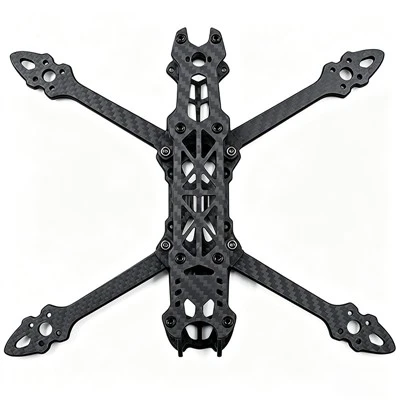
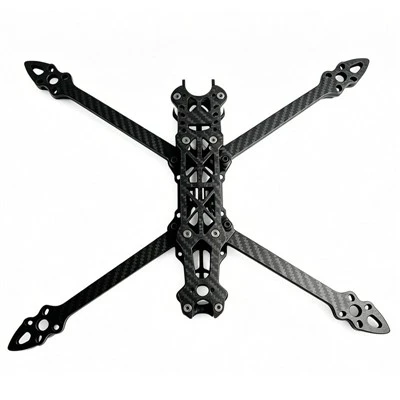
A True-X frame is perfectly symmetrical. If you draw lines connecting the center points of all four motors, they form a perfect square. The distance between the front motors is identical to the distance between the front and rear motors, and the flight controller sits exactly at the intersection of the diagonal lines.

Aerodynamic & Mechanical Physics
Because the layout is perfectly square, the pitch axis (tilting forward/backward) and the roll axis (tilting left/right) share identical moments of inertia. The distance from the center of mass to any given motor is uniform.
- Symmetrical Torque: When you command a roll or a pitch, the flight controller instructs the motors to scale output identically. The leverage applied to rotate the craft is uniform across both axes.
- Predictable Tuning: Betaflight, PID controller algorithms, and dynamic filters operate best under symmetrical conditions. True-X frames require less software-level compensation because the physical forces are inherently balanced.
Flight Characteristics
True-X frames offer the most neutral, locked-in, and predictable flight feel possible.
- A roll maneuvers exactly like a pitch.
- Cornering feels uniform regardless of the angle of attack.
- Robotic precision makes it the premier choice for competitive racing and high-speed, technical freestyle.
The Trade-Off: Props in View
Because the front motors are pulled tight toward the center line to maintain the square layout, the propellers sit directly in front of the camera pod. If you mount a cinematic action camera or look through a wide-angle FPV camera lens, a significant portion of your view will be blocked by spinning propellers.
2. Squashed-X (and Wide-X) Geometry: Compact Snappiness for Freestyle

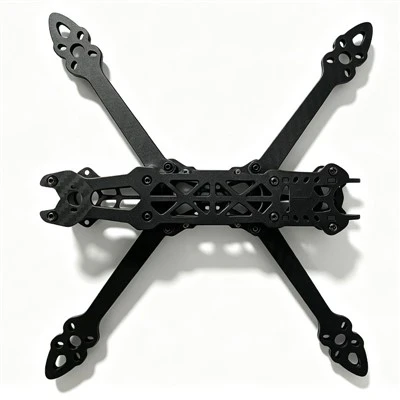
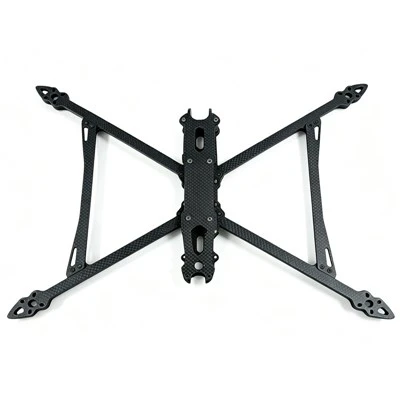
A Squashed-X frame compresses the distance between the front and rear motors while widening the distance side-to-side. Conversely, a Wide-X layout stretches the front-to-back distance and narrows the width. Both variations smash the perfect square into a rectangle.
Aerodynamic & Mechanical Physics
Altering the length-to-width ratio shifts the distribution of mass and changes the leverage each motor possesses over different axes.
- Asymmetric Moments of Inertia: In a standard Squashed-X layout, the front and rear motors are closer together. This shorter body length drastically reduces the pitch moment of inertia, meaning it takes less force to rotate the drone along its pitch axis.
- Leverage Imbalance: Because the side-to-side distance is wider, the motors have massive leverage to execute crisp rolls, but less physical leverage to execute pitches.
Flight Characteristics
Squashed-X frames are famously characterized by an incredibly snappy pitch response and a highly aggressive freestyle feel.
- Sudden flips feel instantaneous, while rolls remain locked-in and stable.
- Many modern freestyle pilots prefer this layout because it allows the central fuselage (containing the heavy battery stack and HD camera) to remain highly compact and centered.
The Trade-Off: Asymmetric PID Tuning
Because the mechanical leverage differs between pitch and roll, your flight controller's PID loop must compensate for the physical asymmetry. If you copy a stock tune meant for a True-X frame onto a Squashed-X frame, you will often notice mid-throttle oscillations, minor prop wash shuddering during sharp pull-outs, or axis drift during complex trick combos. Tuning a Squashed-X frame requires distinct D-term and P-term balances for pitch versus roll.
3. Deadcat Geometry: Pure Cinematic Exploration
The Deadcat layout was engineered to solve one specific problem: getting propellers out of the camera's field of view without needing a massive, overly heavy fuselage. In a Deadcat frame, the front arms are swept wide out to the sides and pushed backward, while the rear arms stay close together or point straight back.

Aerodynamic & Mechanical Physics
The Deadcat configuration features the most extreme physical asymmetry of any mainstream quadcopter layout.
- Displaced Motor Intersection: If you draw diagonal lines connecting the motors, their intersection point no longer aligns with the center of your carbon fiber frame or the physical placement of your flight controller/ESC stack.
- Dirty Air Flow: The unique arm angles mean the rear propellers do not track cleanly behind the front propellers. They operate in highly distorted, turbulent air generated by the wide-swept front arms, especially at high cruising speeds.
Flight Characteristics
Deadcat frames deliver a superb, uninhibited cinematic experience.
- The primary benefit is a completely clear, cinematic field of view. You can tilt your FPV or HD action camera down to low angles or wide-open perspectives without capturing a single millimeter of prop-blade reflection.
- It behaves beautifully during sweeping, banking turns, making it the industry standard for long-range cruising, mountain surfing, and real estate filmmaking.
The Trade-Off: Complex Physics and Tuning Anomalies
Deadcat frames are completely unsuited for aggressive racing or tight, technical freestyle tricks.
- The "Wobble" Effect: Because the front and rear motors sit at completely different geometric distances from the center of gravity, demanding a rapid roll or yaw causes the drone to slightly pitch or wobble. The flight controller is constantly fighting an uphill battle to keep the axes isolated.
- Heavy Software Compensation: To fly smoothly, Deadcat builds rely heavily on Mixer configurations in Betaflight (which tell the flight controller exactly where the motors are placed relative to the gyro) and require aggressive filtering to smooth out the turbulent airflow hitting the rear stators.
Direct Architectural Comparison
| Feature / Metric | True-X | Squashed-X | Deadcat |
|---|---|---|---|
| Physical Shape | Perfect Square | Horizontal Rectangle | Asymmetrical / Front-Swept |
| Handling Feel | Purely Neutral & Balanced | Ultra-Snappy Pitch | Sweeping & Carving |
| Tuning Difficulty | Very Easy / Default | Moderate (Axis Isolation) | Complex (Mixer adjustments) |
| Propellers in HD View | High Presence | Moderate to High | Completely Clean |
| Primary Use Case | Racing & Precision Acro | Cinematic Freestyle | Long-Range & Commercial Cinematography |
Which Layout is Right For Your Next Build?
Choosing a frame geometry is ultimately a matter of mapping your goals as a pilot to the mechanical realities of the carbon fiber layout:
Choose a True-X frame
If your goal is chasing lap times on a track or practicing hyper-precise, robotic freestyle movements where predictability is everything.
01
Choose a Squashed-X frame
If you want an agile, compact freestyle ripper for bando bashing and trick combos, and you don't mind seeing a bit of prop blur in your peripheral view.
02
Choose a Deadcat frame
If you are a content creator, long-range cruiser, or commercial videographer whose primary metric of success is capturing perfectly clean, cinematic HD footage.
03
FAQ
Q: What is the main difference between True‑X, Squashed‑X and Deadcat FPV frame?
A: True‑X is perfectly square and symmetrical for balanced flight and easy tuning. Squashed‑X/Wide‑X are rectangular layouts with snappy but asymmetric response. Deadcat uses swept front arms to clear propellers out of the camera view, best for cinematic footage.
Q: Which frame layout is best for FPV racing?
A: True‑X is the top choice for racing. Its identical inertia on pitch and roll delivers predictable, repeatable handling which is critical for consistent lap times.
Q: Can I use a True‑X PID tune directly on a Squashed‑X frame?
A: Not recommended. Squashed‑X has unequal mechanical leverage for pitch and roll. A True‑X stock tune may cause mid‑throttle oscillation or prop wash wobble; you need separate PID values for pitch and roll.
Q: Does Deadcat frame always have zero prop in frame?
A: In most normal camera tilt angles, Deadcat avoids prop blades. At extreme high tilt or aggressive maneuvers, prop blur may still appear occasionally.
Q: Is Deadcat frame harder to tune than True‑X?
A: Yes. Deadcat is highly asymmetrical. It requires correct Betaflight mixer setup and heavier filtering to suppress turbulence-induced wobble. It is not ideal for racing or tight freestyle tricks.
Q: What is Wide‑X layout used for?
A: Wide‑X stretches front‑rear distance and narrows side width. It improves pitch stability and is commonly used for long-range cruising builds.
More industry knowledge about FPV drone frames